
CLIMATE 1 Lesson Note
LEARNING OBJECTIVES
This SS2 Geography lesson note covers CLIMATE 1 for First Term, Week 5.
Lesson Note
LEARNING OBJECTIVES
At the end of the lesson, students should be able to:
1. Define climate.
2. Identify and explain the factors affecting climate.
3. Describe the Greek and Köppen classifications of climate.
4. Identify the major subcategories of Köppen’s classification system.
5. State the advantages and disadvantages of the different climate classification types.
FACTORS AFFECTING CLIMATE
Climate is the average weather condition of a place observed over a long period, usually 30 years or more.
The following are the major factors affecting climate:
1. Latitude: Places near the Equator receive more direct sunlight and are generally hotter than places near the poles.
2. Altitude: Temperature decreases as altitude increases. Therefore, highland areas are usually cooler than lowland areas.
3. Distance from the sea: Coastal areas usually experience moderate temperatures, while places far inland may experience greater temperature differences.
4. Ocean currents: Warm ocean currents increase the temperature of nearby coastal areas, while cold currents reduce temperatures and may contribute to dry conditions.
5. Prevailing winds: Winds carry the temperature and moisture characteristics of the areas from which they originate. Moist winds bring rainfall, while dry winds may produce dry conditions.
6. Relief or topography: Mountains influence rainfall and temperature. Windward slopes often receive heavy rainfall, while leeward slopes may experience a rain-shadow effect.
7. Vegetation: Forests and other vegetation provide shade and release moisture into the atmosphere through transpiration, thereby influencing local temperature and humidity.
8. Air masses: Large bodies of air with similar temperature and moisture characteristics influence the weather and climate of the regions they move into.
9. Human activities: Deforestation, urbanisation, industrial activities and the burning of fossil fuels can alter local climates and contribute to global climate change.
DESCRIPTION OF GREEK AND KÖPPEN CLASSIFICATION OF CLIMATE
A. GREEK CLASSIFICATION OF CLIMATE
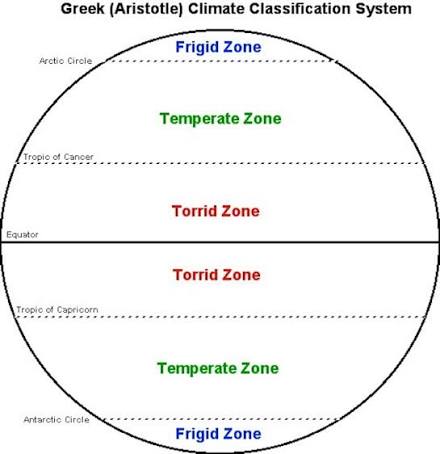
The Greek classification of climate is an early system of classifying climates according to the heat received by different parts of the Earth. It is traditionally associated with the ancient Greek scholar Aristotle.
The traditional system divides the Earth into three main climatic zones:
1. Torrid Zone: This is the hot region around the Equator, lying between the Tropic of Cancer and the Tropic of Capricorn. It receives strong solar radiation throughout the year.
2. Temperate Zones: These are the regions between the tropics and the polar circles in both hemispheres. They generally experience moderate temperatures and seasonal changes.
3. Frigid Zones: These are the cold regions around the North and South Poles, beyond the Arctic and Antarctic Circles. They receive less direct solar radiation and experience very low temperatures.
Limitation: This traditional classification is very broad. It does not adequately explain differences in rainfall, humidity, seasonal conditions and local climates within each zone.
B. KÖPPEN CLASSIFICATION OF CLIMATE
The Köppen classification of climate was developed by the German climatologist Wladimir Köppen. It classifies the world's climates mainly according to average temperature, precipitation and the distribution of vegetation.
The system uses capital letters to identify five major climate groups:
A – Tropical climates
B – Dry climates
C – Temperate climates
D – Continental climates
E – Polar climates
Some versions also recognise H – Highland climates, although this is not one of the five original main groups.
Köppen's system is widely used because it provides a more detailed classification than the traditional Greek system.
MAJOR SUBCATEGORIES OF KÖPPEN'S CLASSIFICATION SYSTEM
A — TROPICAL CLIMATES
These climates have high temperatures throughout the year, with every month's average temperature generally at least 18°C.
* Af – Tropical rainforest climate: Heavy rainfall occurs throughout the year. Example: parts of the Amazon Basin.
* Am – Tropical monsoon climate: Very heavy seasonal rainfall occurs, with a shorter dry season. Example: parts of coastal India.
* Aw/As – Tropical savanna climate: There is a distinct wet and dry season. Example: parts of Nigeria.
B — DRY CLIMATES
These climates receive insufficient precipitation compared with the amount of moisture lost through evaporation and transpiration.
* BW – Desert climate: Extremely dry, with very little rainfall.
* BS – Steppe climate: Semi-arid conditions, generally supporting grasses and shrubs.
The letters h and k may be added to distinguish hot and cold dry climates respectively, as in BWh and BSk.
C — TEMPERATE CLIMATES
These climates generally have mild winters and moderate to warm summers.
* Cfa/Cwa – Humid subtropical climates: Usually have hot summers, with rainfall throughout the year or concentrated in summer.
* Cfb – Marine west coast climate: Has mild summers, cool winters and rainfall distributed through much of the year.
* Csa/Csb – Mediterranean climates: Have dry summers and wetter winters.
D — CONTINENTAL CLIMATES
These climates are mainly found in the interiors and eastern parts of large continents in the Northern Hemisphere. They usually experience large seasonal temperature differences.
* Dfa/Dfb – Humid continental climates: Have warm or hot summers and cold winters.
* Dfc/Dfd – Subarctic climates: Have short, cool summers and long, very cold winters.
E — POLAR CLIMATES
These climates experience very low temperatures throughout the year. The warmest month's average temperature remains below 10°C.
ET – Tundra climate: The warmest month averages between 0°C and below 10°C. Vegetation is limited mainly to mosses, lichens and small shrubs.
EF – Ice cap climate: The warmest month's average temperature remains below 0°C, so permanent ice and snow dominate.
H — HIGHLAND CLIMATE
Highland climates occur in mountainous areas where altitude strongly affects temperature, rainfall and vegetation. Conditions may change considerably over short distances.
Note: Highland climate is often added in practical adaptations of the Köppen system, but it is not one of the five original major groups.
ADVANTAGES AND DISADVANTAGES OF THE CLASSIFICATION TYPES
A. GREEK CLASSIFICATION
Advantages
1. It is simple and easy to understand.
2. It divides the Earth into broad climatic zones.
3. It helps beginners understand the relationship between latitude and temperature.
4. It provides a basic introduction to the study of climate.
Disadvantages
1. It is too broad to explain the many climatic differences found around the world.
2. It gives insufficient attention to rainfall and seasonal variations.
3. It does not adequately consider altitude, ocean currents and relief.
4. It cannot accurately classify many local and regional climates.
5. Its broad zones do not always correspond to actual climatic conditions.
B. KÖPPEN CLASSIFICATION
Advantages
1.It uses measurable temperature and rainfall data.
2. It provides a more detailed classification of world climates.
3. It considers the relationship between climate and natural vegetation.
4. It helps geographers compare climatic regions.
5.It is useful in agriculture, ecological studies and environmental planning.
Disadvantages
It requires reliable temperature and rainfall rrecords.
Its letter codes may be difficult for beginners to remember.
3. Boundaries between climate types can be gradual rather than clear-cut.
4. It does not fully explain the causes of climatic conditions.
5. It may not adequately represent local microclimates or recent climate changes.
Evaluation
OBJECTIVE QUESTIONS
Choose the correct answer from options A–D.
1. Climate refers to the average weather condition of a place over a ______ period.
A. short
B. long
C. daily D. weekly
2. Which of the following factors affects climate?
A. Latitude
B. Handwriting
C. Population alone
D. Language
3. The Torrid Zone lies between the ______.
A. Arctic and Antarctic Circles
B. Tropic of Cancer and Tropic of Capricorn
C. Equator and North Pole
D. North Pole and South Pole
4. Who developed the Köppen classification of climate?
A. Isaac Newton
B. Wladimir Köppen
C. Albert Einstein
D. Charles Darwin
5. Which letter represents tropical climates in the Köppen system?
A. A
B. B
C. C
D. E
6. The Köppen group used for dry climates is ______.
A. A
B. B
C. D
D. E
7. Which Köppen climate type is associated with tropical rainforest conditions?
A. Af
B. BW
C. ET
D. EF
8. Which climate type is associated with desert conditions?
A. Af
B. BW
C. Cfb
D. Dfb
9. Which of the following is a major limitation of the Greek classification?
A. It is too detailed.
B. It requires complex computer models.
C. It is too broad to explain regional climatic differences.
D. It uses too many climatic measurements.
10\. In the Köppen classification, ET represents ______.
A. Ice cap climate
B. Tundra climate
C. Tropical monsoon climate
D. Desert climate
Theory Questions
Answer the following theory questions.
1a. Define climate and explain five factors affecting climate.
1b. Describe the three climatic zones in the traditional Greek classification.
1c. Explain the Köppen classification of climate.
2a. List and explain the five major groups of Köppen's classification system.
2b. State four advantages and four disadvantages each of the Greek and koppen classification of climate.