
ACTION OF WAVES Lesson Note
LEARNING OBJECTIVES
This SS2 Geography lesson note covers ACTION OF WAVES for First Term, Week 4.
Lesson Note
LEARNING OBJECTIVES
By the end of the lesson, students should be able to:
1. Define wave action.
2. Explain how waves are formed.
3. Identify the types of wave action.
4. Explain the processes of coastal erosion by waves.
5. State the features formed by wave action.
INSTRUCTIONAL MATERIALS
Pictures of coastal areas.
Diagrams of cliffs, caves, arches and stacks.
Geography textbook.
Maps and photographs of coastlines.
A. DEFINITION OF WAVE ACTION
Wave action refers to the processes by which sea waves erode, transport and deposit materials along the coastline.
Waves are mainly formed when wind blows across the surface of the sea or ocean. The strength and size of waves depend on wind speed, the duration of the wind and the distance over which the wind blows.
B. TYPES OF WAVE ACTION
There are two major types of breaking waves based on their effects on the coastline.
1. Constructive Waves
These are waves that deposit more materials on the beach than they remove. They help to build up beaches.
Characteristics of constructive waves:
a. They have a strong swash.
b. They have a relatively weak backwash.
c. They deposit sand and pebbles along the coast.
d. They help to build and widen beaches.
2. Destructive Waves
These are waves that remove more materials from the beach than they deposit. They are responsible for much coastal erosion.
Characteristics of destructive waves:
a. They have a relatively weak swash.
b. They have a strong backwash.
c. They remove sand and other materials from beaches.
d. They may cause the coastline to retreat.
C. PROCESSES OF COASTAL EROSION BY WAVES
There are four major processes of wave erosion.
1. Hydraulic Action
This occurs when waves strike cracks in coastal rocks. Water and compressed air exert pressure on the cracks, gradually breaking the rocks apart.
2. Abrasion (Corrasion)
This occurs when waves throw sand, pebbles and rock fragments against the coastline, wearing away the rocks.
3. Attrition
This occurs when rock fragments carried by waves collide with one another, breaking into smaller and smoother pieces.
4. Solution (Corrosion)
This occurs when seawater dissolves soluble minerals in coastal rocks, especially limes by corrosion
D. FEATURES FORMED BY WAVE EROSION
The following landforms are produced by wave erosion:
1. Cliffs: Steep rock faces along the coastline formed when waves erode the base of the land.
2. Wave-cut Notches: Indentations formed at the foot of cliffs through continuous wave erosion.
3. Wave-cut Platforms: Broad, gently sloping rocky surfaces left behind as cliffs retreat.
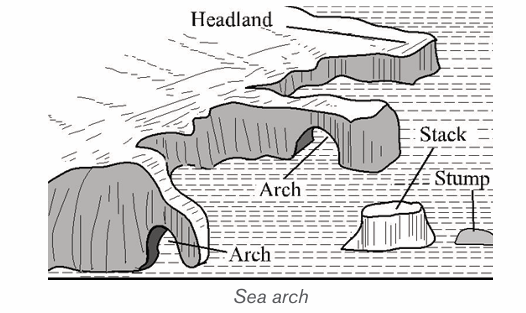
4. Sea Caves: Hollow openings formed when waves enlarge cracks in coastal rocks.
5. Sea Arches: Openings formed when a sea cave cuts through a headland.
F. Sea Stacks: Isolated pillars of rock left standing after a sea arch collapses.
E. FEATURES FORMED BY WAVE DEPOSITION
Wave deposition occurs when waves lose energy and drop the materials they carry.
The major depositional features include:
1. Beaches: Accumulations of sand, pebbles and other materials along the shore.
2. Spits: Long, narrow ridges of sand or shingle extending from the coast into the sea or across an estuary.
3. Bars: Ridges of deposited sand or shingle that extend across a bay or may partially enclose a lagoon.
4. Tombolos: Depositional ridges that connect an island to the mainland or another island.
F. IMPORTANCE OF WAVE ACTION
1. It helps to shape coastal landscapes.
2. It creates attractive beaches for tourism and recreation.
3. It breaks down rocks and produces sediments.
4. It transports materials along the coastline.
5. It creates habitats for coastal plants and animals.
6. It may also damage coastal settlements, roads and buildings through erosion.
WEEKLY EVALUATION OBJECTIVE QUESTIONS
Choose the correct answer from options A–D.
1\. Wave action refers to the processes by which sea waves ______.
A. Form mountains
B. Erode, transport and deposit materials
C. Produce rainfall
D. Create deserts
2. The major cause of ordinary sea waves is ______.
A. Wind
B. Earthquakes only
C. Volcanic eruptions
D. Underground water
3. Which of the following is a process of wave erosion?
A. Condensation
B. Hydraulic action
C. Evaporation
D. Transpiration
4. The wearing away of coastal rocks by sand and pebbles carried by waves is called ______.
A. Abrasion
B. Attrition
C. Solution
D. Deposition
5. The collision of rock fragments carried by waves is known as ______.
A. Hydraulic action
B. Attrition
C. Solution
D. Transportation
6. A hollow opening formed by wave erosion in a coastal cliff is called a ______.
A. Spit
B. Bar
C. Sea cave
D. Beach
7. A sea arch may develop from a ______.
A. Sea cave
B. Beach
C. Sand dune
D. Delta
8. An isolated pillar of rock left after the collapse of a sea arch is called a ______.
A. Lagoon
B. Sea stack
C. Spit
D. Tombolo
9. Which of the following is a depositional feature?
A. Sea cliff
B. Wave-cut notch
C. Sea cave
D. Spit
10. Constructive waves generally help to ______.
A. Build up beaches
B. Destroy all coastal rocks
C. Form volcanic mountains
D. Increase rainfall
THEORY QUESTIONS
1a. Define wave action.
1b. Explain the four processes of coastal erosion by waves.
1c. Differentiate between constructive waves and destructive waves.
2a. Explain how sea caves, sea arches and sea stacks are formed.
2b. List and explain four features formed by wave deposition.