
The earth’S external process and landforms development. Lesson Note
This SS2 Geography lesson note covers The earth’S external process and landforms development. for First Term, Week 1.
Learning Objectives
- At the end of the lesson, students should be able to:
- 1. Explain water as an agent of erosion and deposition.
- 2. Describe water as an energy system.
- 3. Identify the stages of a river and their characteristics.
- 4. Explain the processes associated with each stage of a river.
- 5. Identify the landforms found in each stage of a river.
- 6. State the benefits of river landforms to humans.
Lesson Note
A. DEFINITION
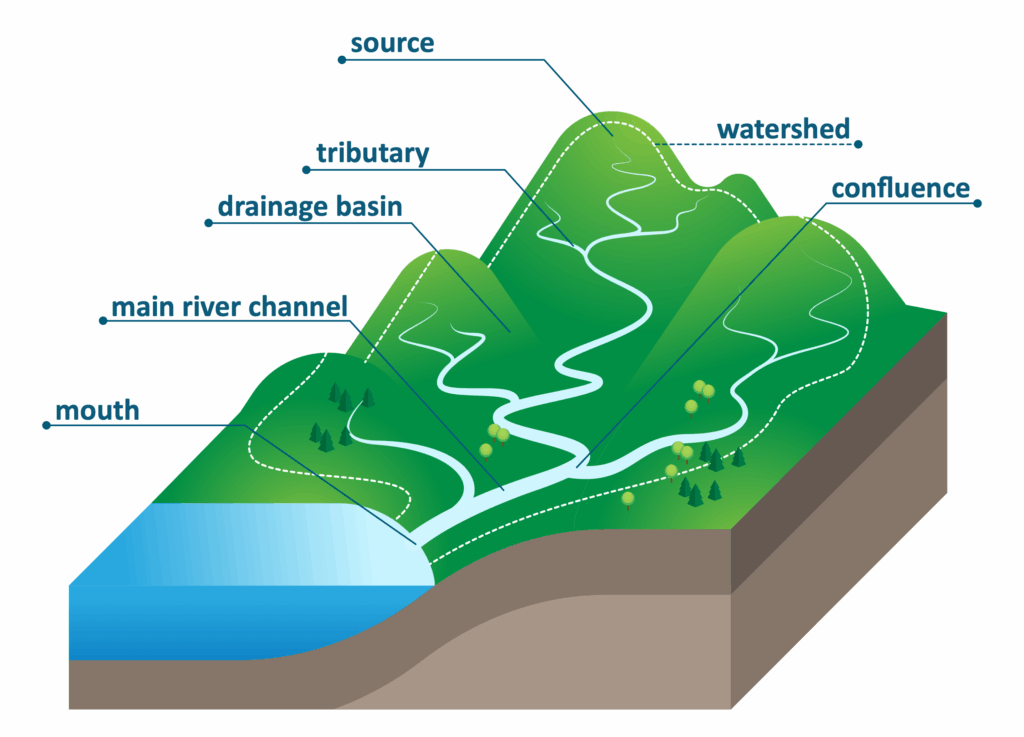
Running water is one of the major external processes that shape the Earth’s surface. Rivers erode, transport, and deposit materials, leading to the formation of various landforms. The amount of work a river performs depends on its speed, volume, and gradient.
B. WATER AS AN ENERGY SYSTEM
Water is regarded as an energy system because it possesses the power to perform work as it flows from higher elevations to lower elevations under the influence of gravity.
C. SOURCES OF RIVER ENERGY
1. Gravity: Gravity provides the force that keeps River water flowing and gives River the energy to shape the land scape through erosion, transportation and deposition.
2. Rainfall: Rainfall provides the water that increases a river's discharge and velocity, giving it more energy to erode, transport, and deposit materials.
3. River gradient (slope): A steep river gradient increases the speed and energy of flowing water, enabling the river to erode, transport, and shape the landscape more effectively.
4. Volume of water (discharge): The greater the volume of water (discharge), the more energy the river has to erode its channel, transport sediments, and shape the landscape.
D. FUNCTION OF RUNNING WATER
1.Erodes rocks and soil: Running water erodes rock and soil by wearing away and removing materials from the river bed and banks, changing the landscape over time.
2.Transports sediments: Running water transports sediment by carrying eroded materials from the river's upper course to lower areas, where they may eventually be deposited.
3.Deposits sediments in lowland areas: Running water transports sediment by carrying eroded materials from the river's upper course to lower areas, where they may eventually be deposited.
4.Shapes different landforms: Running water deposits sediments in lowland areas when it slows down and loses energy, leaving behind the materials it was carrying and creating fertile land and other river landforms.
E. STAGES OF A RIVER AND THEIR CHARACTERISTICS
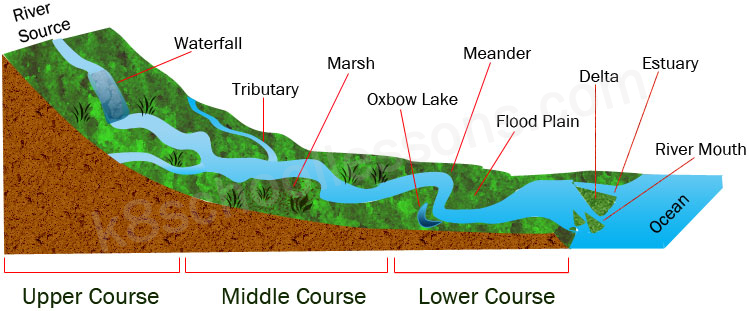
1. UPPER (YOUTHFUL) STAGE
CHARACTERISTICS
i) Steep Gradient (Slope):
The river flows down a very steep slope, causing the water to move quickly.
ii) Narrow and Shallow Channel:
iii) The river channel is usually narrow and shallow because it has not yet collected much water from tributaries.
iv) Vertical Erosion is Dominant:
The river mainly erodes downward into its bed, forming features such as V-shaped valleys, waterfalls, and gorges.
F. PROCESSES
The upper (youthful) stage of a river is the first stage of a river’s development, beginning at its source in hills or mountains.
Process of the upper (youthful) stage:
i) The river flows rapidly down a steep slope due to gravity.
ii) Because of its high speed, vertical erosion (downward cutting into the river bed) is the main process.
iii) The river cuts deep into the land, creating V-shaped valleys.
iv) Large rocks carried by the river wear away the river bed through abrasion and hydraulic action.
v) Waterfalls and rapids may form where the river flows over hard and soft rocks.
vi)Little deposition occurs because the fast-flowing water has enough energy to carry most of its load downstream.
G. FEATURES ASSOCIATED WITH UPPER(YOUTHFUL)STAGE OF A RIVER AND THEIR BENEFIT TO MAN
1. V-shaped Valleys
Benefit: Provide land for grazing and attract tourists because of their scenic beauty.
2.Waterfalls
Benefit: Can be used to generate hydroelectric power (HEP) and are important tourist attractions.
3.Rapids
Benefit: Attract tourists for water sports such as rafting and kayaking, creating jobs and income.
4.Gorges
Benefit: Suitable sites for building dams and reservoirs for electricity generation and water supply.
5.Interlocking Spurs
Benefit: Scenic landscapes that promote tourism and nature conservation.
6.Potholes
Benefit: They demonstrate the erosive work of rivers and are useful for geography education and tourism
H. MIDDLE COURSE OF A RIVER
CHARACTERISTICS
i) The river is wider and deeper than in its upper course.
ii) The slope (gradient) is gentler.
iii) The river flows more slowly.
iv) The volume of water increases because of tributaries joining the main river.
v) Lateral (sideways) erosion becomes more important than vertical erosion.
I. PROCESSES
1. Lateral erosion: The river erodes its banks, making the channel wider.
2. Transportation: The river carries sediments mainly by suspension and saltation.
3. Deposition: Some materials are deposited where the river loses energy, especially on the inside bends of meanders.
J. FEATURES AND BENEFIT TO MAN
1. Meander
provide fertile land for farming and attractive scenery for tourism.
2. Floodplains
Fertile soils support agriculture and grazing.
3.River Cliffs
Can be used for geological studies and tourism.
4.Slip-off Slopes
Suitable for farming because of deposited fertile soil.
5.Bluffs
May provide sites for settlement above flood level and scenic viewpoints.
K. LOWER COURSE OF A RIVER
CHARACTERISTICS
i) The river is very wide and very deep.
ii) It has a very gentle slope (gradient).
3.The river flows slowly.
iii) It carries a large volume of water.
iv) Deposition is greater than erosion because the river has less eerosion
v) The river is close to its mouth, where it enters a sea, lake, or ocean.
L. PPROCESSES
1. Deposition: The river deposits fine sediments such as silt, sand, and clay.
2. Transportation: Fine materials are carried mainly in suspension and solution.
3. Minimal erosion: Very little erosion occurs because the river flows slowly.
M. FEATURES AND THEIR BENEFIT TO Floodplain
1. Fertile land for farming and grazing livestock.
2. Natural Levee
Help reduce flooding and provide raised land for settlements and roads.
3. Delta
Fertile soils for agriculture, fishing, oil and gas exploration (in some regions), and settlement.
4. Distributaries
Provide water for irrigation, fishing, and transport.
5 Estuary
Supports fishing, ports, shipping, tourism, and wildlife habitats.
Evaluation
OBJECTIVE QUESTIOS
1. Which of the following best describes water as an energy system? A. Water remains stationary throughout its course. B. Water uses energy to erode, transport, and deposit materials. C. Water flows only during the rainy season. D. Water has no effect on the landscape.
2. Which stage of a river is characterized by steep slopes and rapid flow? A. Upper course B. Middle course C. Lower course D. Delta
3. Which of the following is a characteristic of the middle course of a river? A. Narrow valley and waterfalls B. Wide valley with meanders C. Very steep gradient D. Deep V-shaped valleys only
4. Which process is mainly responsible for wearing away the river channel and its banks? A. Deposition B. Erosion C. Evaporation D. Condensation
5. Which river feature is commonly formed in the upper course due to vertical erosion? A. Floodplain B. Delta C. Waterfall D. Levee
6. Which of the following river features is formed by deposition in the lower course?
A. Gorge
B. Meander
C. Delta
D. Rapids
7. Which river feature is formed when a meander is cut off from the main river?
A. Gorge
B. Oxbow Lake
C. Waterfall
D. Levee
8. Which of the following is an important benefit of river features to humans?
A. They prevent all forms of flooding.
B. They provide water for irrigation, transport, and hydroelectric power.
C. They stop soil erosion completely.
D. They reduce rainfall.
9. Which process mainly occurs in the lower course of a river?
A. Vertical erosion
B. Transportation only
C. Deposition
D. Weathering only
10. Which of the following best explains the importance of rivers and their features to human activities?
A. They make farming impossible.
B. They support fishing, tourism, transportation, and agriculture.
C. They prevent people from settling nearby.
D. They reduce the supply of fresh water.
Theory Questions
1a) Explain water as an energy system
b) Identify the stages of a river and their characteristics
2a) Identify the features of each stage of a river and state their benefit to Man
b) Mention the features and benefits of lower course of river