
Glaciers Action Lesson Note
Learning Objectives
This SS2 Geography lesson note covers Glaciers Action for First Term, Week 3.
Lesson Note
Learning Objectives
At the end of the lesson, students should be able to:
i. Explain the concepts associated with coastland.
ii. Describe the processes of wave erosion.
iii. Identify the characteristics of features formed by coastal erosion and deposition.
iv. Explain the impact of wave action on humans and the coastland.
Introduction
Coastlands are areas where the land meets the sea. They are constantly shaped by natural agents such as waves, tides, currents, and wind. These processes either erode the coastline or deposit materials to form different coastal landforms.
Concepts Associated with Coastland
The following concepts are important in the study of coastlands:
1. Coast: The meeting point between land and sea.
2. Coastline: The line where the land meets the sea.
3. Shore: The narrow strip of land bordering the sea.
4. Beach: A gently sloping accumulation of sand, pebbles, or shells along the shoreline.
5. Wave: A movement of seawater generated mainly by wind.
6. Tide: The regular rise and fall of sea level caused by the gravitational pull of the moon and the sun.
7. Current: The continuous, direct movement of ocean water/seawater driven by wind, gravity, the Earth's rotation, and water density differences.
Processes of Wave Erosion
Wave erosion is the wearing a way of rocks along the coastline by sea waves.
The major processes include:
1. Hydraulic Action: The force of waves forces air into cracks in rocks, causing them to break.
2. Abrasion (Corrasion): Waves carrying sand and pebbles scrape and wear away rocks.
3. Attrition: Rock fragments carried by waves collide with one another, becoming smaller and smoother.
4. Solution (Corrosion): Seawater dissolves soluble rocks such as limestone.
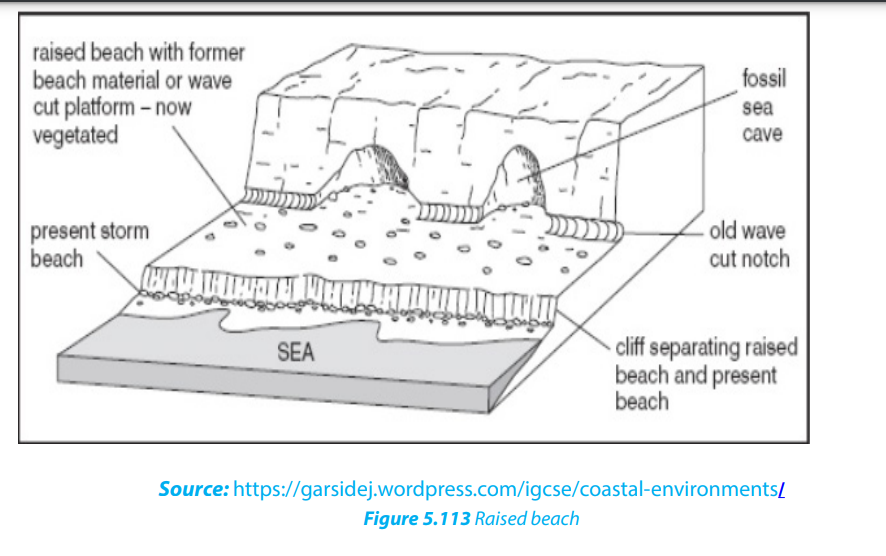
Features of Coastal Erosion
1. Cliffs: Steep rock faces formed by continuous wave attack.
2. Wave-cut Platform: A flat rocky surface left after cliff erosion.
3. Sea Cave: A hollow formed when waves enlarge cracks in rocks.
4. Sea Arch: Formed when a cave cuts through a headland.
5. Sea Stack: An isolated pillar of rock formed after an arch collapses.
6. Sea Stump: The remains of a stack worn down by erosion.
Features of Coastal Deposition
1. Beach: Deposited sand and pebbles along the shoreline.
2. Spit: A long narrow ridge of sand extending into the sea.
3. Bar: A ridge of sand joining two headlands.
4. Lagoon: A shallow water body separated from the sea by a bar or spit.
5. Sand Dunes: Hills of wind-blown sand found near beaches.
Impact of Wave Action on Man and Coastland
Positive Impacts
1. Promotes tourism through beautiful beaches.
2. Provides fishing grounds.
3. Creates natural harbours for shipping.
4. Supplies sand and gravel for construction.
Negative Impacts
1. Causes coastal erosion and land loss.
2. Destroys buildings, roads, and other infrastructure.
3. Leads to flooding of coastal settlements.
4. Threatens human lives and property.
5. Damages farmland and vegetation.
Evaluation
OBJECTIVE QUESTIONS
1. A glacier is best described as
A. A fast-flowing river
B. A large mass of moving ice formed from accumulated snow
C. Frozen seawater along the coast
D. Underground ice deposits
2. Which of the following conditions favours the formation of glaciers?
A. High temperature and low rainfall
B. Low temperature and heavy snowfall
C. High temperature and strong winds
D. Low rainfall and dry climate
3. Which of the following is a major agent of glacial erosion?
A. Running water
B. Wind
C. Moving ice
D. Ocean currents
4. Which process involves the glacier freezing onto rocks and pulling them away as it moves?
A. Hydraulic action
B. Plucking
C. Attrition
D. Solution
5. Which of the following is a glacial erosional landform?
A. Delta
B. Sand dune
C. U-shaped valley
D. Meander
6. A moraine is best described as:
A. A deep coastal inlet
B. A deposit of rock debris left by a glacier
C. A volcanic mountain
D. A river floodplain
7. Which of the following is a glacial depositional feature?
A. Sea arch
B. Drumlin
C. Waterfall
D. Gorge
8.The bowl-shaped depression found at the head of a glacial valley is called a:
A. Cirque
B. Delta
C. Plateau
D. Levee
9. Which of the following is an economic importance of glaciers?
A. They provide a source of fresh water.
B. They increase desertification.
C. They prevent rainfall.
D. They cause volcanic eruptions.
10. Which of the following is a negative effect of glaciers?
A. Formation of fertile plains
B. Attraction of tourists
C. Destruction of roads and settlements through ice movement
D. Improvement of navigation in rivers
Theory Questions
1a. Explain the concept associated with coastland
1b. Describe the process of wave erosion
2a. Identify and explain the characteristics of coastal erosion and deposition features
2b. Discuss the impact of wave action on humans