
ACTION OF WIND Lesson Note
Learning Objectives
This SS2 Geography lesson note covers ACTION OF WIND for First Term, Week 2.
Lesson Note
Learning Objectives
By the end of the lesson, students should be able to:
i. Explain the types and characteristics of deserts.
ii Describe the processes of wind erosion.
iii Identify the features formed by wind erosion and wind deposition.
iv Analyze the strategies people use to survive in desert environments.
A. INTRODUCTION
Wind is an important agent of erosion, transportation, and deposition, especially in dry regions where there is little vegetation. In deserts, wind shapes the landscape by removing, carrying, and depositing soil and rock particles.
Examples of Desert:
sahara desert(west Africa)
kalahari and Namib desert (South Africa)
Arabian,Iranian and Thar desert (middle east)
Australian desert(Australia)
Atacama desert (South America)
Mohave desert (U.S.A)
B. TYPES OF DESERTS
There are five distinct kind of desert landscape. These are:
(1) Erg or Sandy desert: These are made up of sand dunes or sheets.
(2) Hamanda or rocky deserts: These are made up of mainly rocks
(3) Reg or stony deserts: These are made up of mainly pepples and gravels.
(4) Badlands: These are desert highly eroded by wind
(5) Mountains desert: These desert are associated with high land areas.
C. CHARACTERISTICS OF DESERTS
1. Very low annual rainfall (less than 250 mm).
2. Sparse vegetation.
3. Extreme temperatures (hot during the day, cold at night in hot deserts).
4. Sandy or rocky surfaces.
5. Strong winds and frequent dust storms.
D. PROCESSES OF WIND EROSION
Wind erodes the land through the following processes:
1. Deflation: Wind removes loose sand and dust from the ground.
2. Abrasion: Wind-blown sand wears away rocks like sandpaper.
3. Attrition: Rock particles carried by wind collide and break into smaller pieces.
E. FEATURES OF WIND EROSION
Features of Wind Erosion include:
1.Rock pedestals (mushroom rocks):
Characteristics:
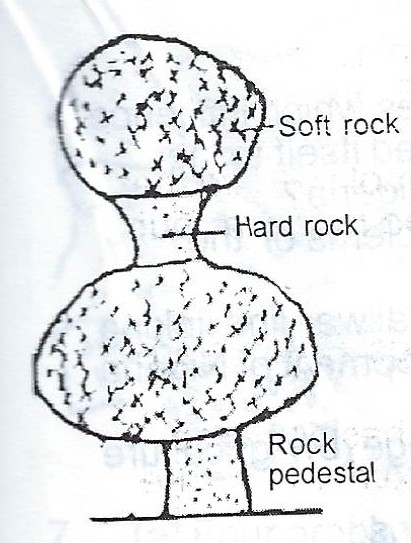
Rock pedestal are irregular shape e.g muchroom shape with alternative layer of hard and soft rocks. They are like pillar in structure, being narrow at the base and broderie at the top.They are desert land form which range from 10 -15 meter in height and are found in desert environments e. g Sahara desert .
Mode of formation:
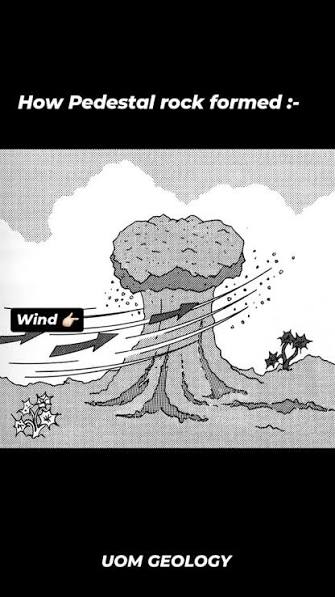
Rock pedestals are formed by wind abrasion on an alternate horizontal layer of hard and soft rocks. The soft rocks are eaten into faster than the hard rocks.
Abrasion is greater at ground level, resulting in serious undercutting to produce irregular shaped features called rock pedestals or gour in desert.
2. Yardangs:
Characteristics:
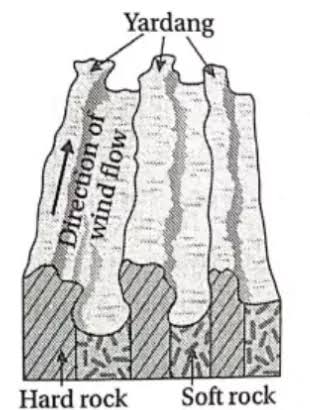
Yardangs have vertical bands of hard and soft rocks, ridge and furrow of landscape of about 10-15 meters long. They are formed in the desert e.g Atacama deserts.
Mode Of Formation
Strong winds carry sand and dust that scrape away rock (abrasion) and blow away loose particles (deflation). Softer rock layers wear away much faster than harder rock layers, leaving long carved ridges behind.
3. Zeugen:
Characteristics:
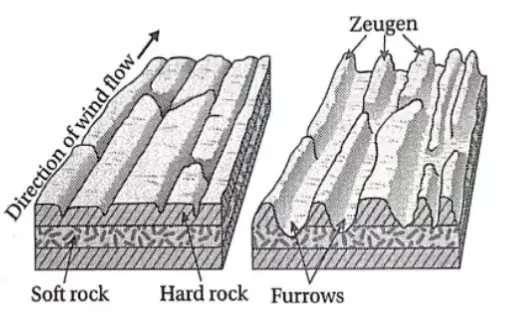
These are tabular masses with a layer of soft rocks lying beneath a surface layer of hard rock. It has a long ridge and furrow land scape with a length of 10-30 meters. They are also formed by wind abrasion in deserts.
Mode of formation
Zeugen is formed when a tabular masses of rock which has a layer of soft rocks lying under a layer of a more resistant hard rock which is lying horizontally to the direction of wind. The mass of rock is then attacked by wind abrasion. This wind abrasion wears the mass into a ridge and furrow land scape leading to the formation of zeugen. Mechanical weathering starts the formation by opening up joints of the surface of hard rocks.
3. Deflation hollows:
Characteristics:
They are formed by wind deflation. It is a desert land form with varying depth. There may be presence of sand dunes on the leeward side. It is a basin and can form oasis in desert e.g fayumi, quattara, Dust bowl.
Mode of formation
As a result of wind deflation,large depression or hollow are produced by the scooping away of loose sandy materials by wind,sometimes,below the water table.When this happens,water seeps out and oasis or swamp are formed.
F. FEATURES OF WIND DEPOSITION
1. Sand dunes: Dunes are hills or ridge of sand formed by Pilling up of ridges of sand into hill – shaped by the action of wind. They are initiated when an obstacles of some kind prevents free movement of wind, thus creating certain shapes against the obstacles until it covers the latter and falls over to the other side. Dunes could be active or inactive with various shapes. There are two main types of dunes, these are barchan and self’s or longitudinal dunes.
2. Loess deposits (fine wind-blown dust): These are loose ,fine particles which are carried by wind. They are deposited outside the desert as loess. Loess is a fine loam, very fertile and deposit. Deposit of loess is found in North west China.
G. MAN’S SUVIVAL STRATEGIES IN DESERTS ENVIRONMENT
1. People survive in deserts by:
2. Practicing irrigation farming near oases.
3. Rearing animals such as camels, goats, and sheep.
4. Building thick-walled houses to reduce heat.
5. Wearing loose, light colored clothing.
6. Conserving water through storage and efficient use.
7. Traveling during cooler periods of the day or at night.
8. Planting drought-resistant crops
Evaluation
OBJECTIVE QUESTIONS
1. Which of the following is not a type of desert?
A. Hot desert
B. Coastal desert
C. Tropical rainforest
D. Cold desert
2. Which characteristic is commonly associated with deserts?
A. Heavy rainfall throughout the year
B. Sparse vegetation and low rainfall
C. Thick forests and fertile soil
D. High humidity all year round
3. Which process of wind erosion involves the lifting and carrying away of fine particles by wind?
A. Deposition
B. Attrition
C. Deflation
D. Weathering
4. The process by which wind-blown sand wears away rocks is known as: A. Abrasion
B. Condensation
C. Erosion by water
D. Sedimentation
5. Which of the following is a feature formed by wind erosion?
A. Sand dune
B. Mushroom rock
C. Delta
D. Floodplain
6. Which landform is mainly formed by wind deposition?
A. Inselberg
B. Yardang
C. Sand dune
D. Gorge
7. Crescent-shaped sand dunes formed by wind are called:
A. Barchans
B. Moraines
C. Drumlins
D. Eskers
8. Which of the following is a strategy people use to survive in deserts?
A. Building houses in floodplains
B. Irrigation farming and water conservation
C. Depending only on rainfall for farming
D. Clearing all vegetation
9. People living in deserts often wear loose, light-coloured clothing mainly because it:
A. Absorbs more heat
B. Helps keep the body cool and protects from the sun
C. Makes walking easier
D. Attracts rainfall
10. Which of the following best explains why population is generally low in desert regions?
A. Too much rainfall
B. Dense forests make settlement difficult
C. Scarcity of water and harsh climatic conditions
D. Frequent volcanic eruptions
EVALUATION (THEORY)
1.(a) What is a desert?
(b) State three examples of deserts in the world.
(c) Explain four characteristics of deserts.
2.(a) Explain the processes of wind erosion.
(b) Describe any three processes by which wind erodes the land surface.
3.(a) Mention, explain and draw two features formed by wind erosion.
(b) Mention and explain three features formed by wind deposition.
4.(a) Explain five strategies people use to survive in desert regions.
(b) State three economic activities commonly carried out by people living in deserts.