
ELECTROLYSIS Lesson Note
Learning Objectives:
This SS3 Physics lesson note covers ELECTROLYSIS for First Term, Week 5.
Lesson Note
Learning Objectives:
By end of lesson, students should be able to:
1. Explain conduction of electricity through liquids
2. Define electrolyte, non-electrolyte, electrolysis
3. Explain conduction through gases
4. List examples and applications
CONTENT
A. ELECTRICAL CONDUCTION THROUGH LIQUIDS
Pure liquids like pure water, oil, do NOT conduct electricity well because they have no free charges.
But when certain substances are dissolved in water, the solution conducts electricity. The substance that makes water conduct is called electrolyte.
DEFINITIONS:
1. Electrolyte: A compound which in molten state or aqueous solution allows electric current to pass through it and is decomposed by it. It contains free mobile ions.
2. Non-Electrolyte: A compound whose solution does NOT conduct electricity. It remains as neutral molecules, no free ions.
3. Electrolysis: The process by which an electrolyte is decomposed by electric current passing through it. Chemical change occurs.
4. Electrolytic Cell: The set up used. Contains: Battery, Electrolyte, Electrodes (Anode +, Cathode −)
5. Ions: Charged atoms. Cation (+) moves to cathode (−). Anion (−) moves to anode (+).
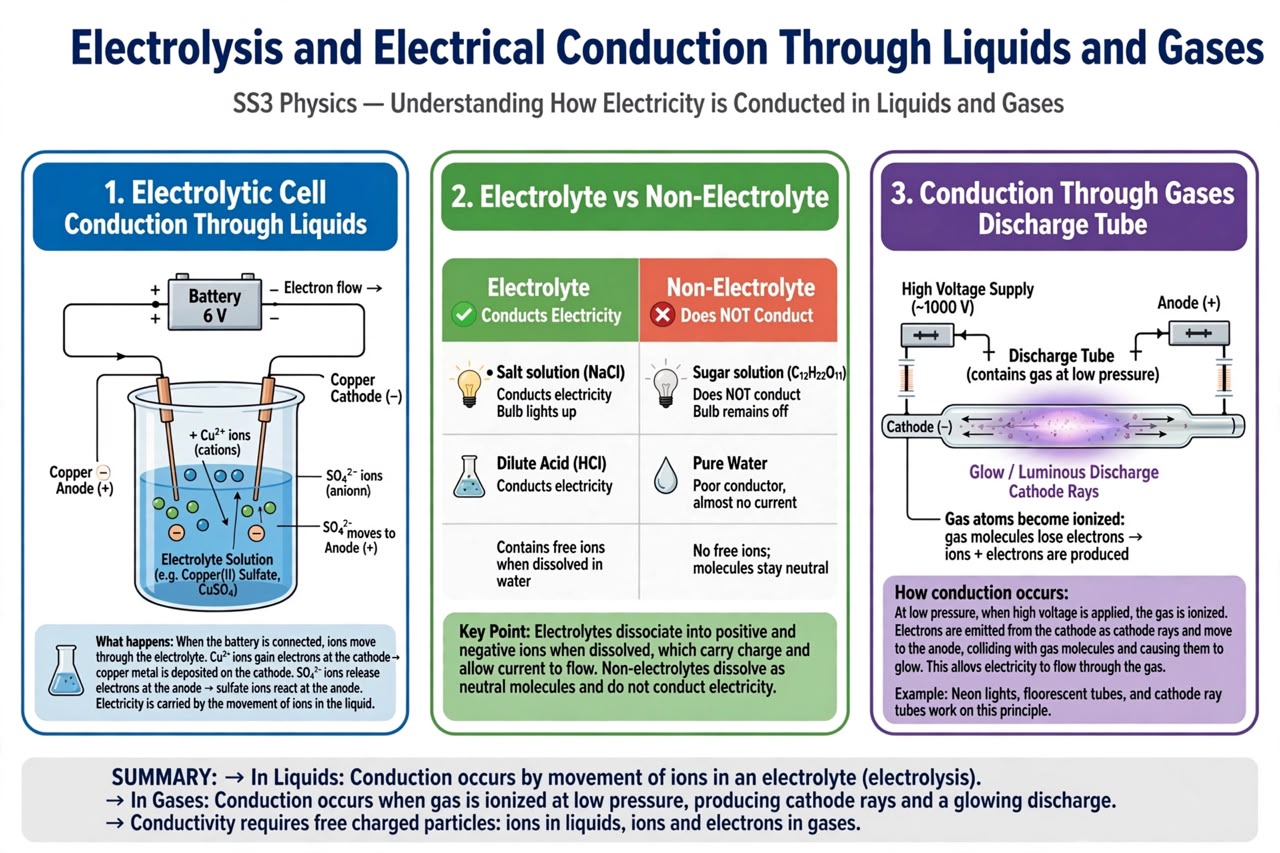
See Diagram 1 in chart: Copper Sulphate CuSO4 solution with copper electrodes.
What happens during electrolysis of CuSO_{4}:
CuSO4 → Cu2+ + SO42−
• Cu2+ (cations) move to cathode, gain 2 electrons and become copper metal deposited: Cu2+ + 2e− → Cu
• SO42− (anions) move to anode and lose electrons.
Electricity is carried by movement of ions, not electrons like in metals.
Faraday's Laws of Electrolysis:
1st Law: Mass of substance liberated at electrode is proportional to quantity of electricity passed:
m = ZIt
where Z = electrochemical equivalent.
2nd Law: Mass liberated is proportional to chemical equivalent when same quantity of electricity is passed.
B. ELECTROLYTE vs NON-ELECTROLYTE
See Diagram 2 in chart.
Electrolyte – Conducts, bulb lights:
1. Acids: HCl, H2SO4, HNO3
2. Alkalis: NaOH, KOH
3. Salts: NaCl, CuSO4, Na2SO4
Properties: Dissociates into ions in water, produces free ions.
Non-Electrolyte – Does NOT conduct, bulb off:
Sugar solution (C12H22O11)
Urea, Alcohol, Kerosene, Pure water, Benzene
Properties: Dissolves as neutral molecules, no ions.
Key Point: For conduction to occur in liquid, there must be free ions.
USES of ELECTROLYSIS:
i) Electroplating – coating one metal with another
ii) Purification of metals e.g. copper
iii) Extraction of metals e.g. aluminium
iv) Production of gases e.g. hydrogen
C. ELECTRICAL CONDUCTION THROUGH GASES
Normally, gases at ordinary pressure are very poor conductors – almost insulators. They have no free charges.
But gases can conduct electricity under two conditions:
a) At LOW PRESSURE (about 0.01 mmHg)
b) With HIGH VOLTAGE (about 1000 V)
Discharge Tube Experiment – See Diagram 3 in chart:
Apparatus: Glass tube with gas at low pressure, two electrodes cathode (−) and anode (+), high voltage.
Observation: When high voltage is applied:
• Gas atoms become ionized: Gas → Gas+ + e−
• Electrons emitted from cathode are called Cathode Rays. They move towards anode at high speed.
• They collide with gas molecules causing glow / luminous discharge.
• Different gases give different colours: Neon = orange-red, Argon = blue, Nitrogen = pink.
HOW CONDUCTION OCCURS IN GASES: Free electrons and positive ions produced by ionization carry the current.
APPLICATIONS OF CONDUCTION THROUGH GASES:
i) Fluorescent tubes and neon advertising lights
ii) Cathode Ray Tube (CRT) in old TVs and CRO
iii) Lightning – natural discharge through air
iv) Street lights – Sodium vapour lamp
DIFFERENCE BETWEEN CONDUCTION IN SOLIDS, LIQUIDS, GASES:
| Medium | Charge Carrier | Condition |
|---|---|---|
| Metal (solid) | Free electrons | Normal |
| Liquid (electrolyte) | Ions (Cu2+, SO42-) | Must have electrolyte |
| Gas | Ions + Electrons | Low pressure + High voltage |
FULL ILLUSTRATION CHART:
4. GENERAL SUMMARY
1. Electricity conduction needs free charged particles.
2. In liquids, only electrolytes conduct because they dissociate into free positive and negative ions. Process is electrolysis. Non-electrolytes do not produce ions, so they don't conduct.
3. In electrolytic cell, Cu2+ goes to cathode to gain electrons and deposit, SO42− goes to anode to lose electrons.
4. Faraday's laws govern amount of substance deposited: m = ZIt
5. Gases are normally insulators but conduct at low pressure and high voltage by ionization producing electrons (cathode rays) and positive ions which carry current and cause glowing discharge.
6. This principle is used in neon lights, fluorescent tubes, electroplating and metal extraction.
Evaluation
OBJECTIVE QUESTIONS
1. The process by which an electrolyte is decomposed by electric current is called:
A) Ionization
B) Electrolysis
C) Discharge
D) Electroplating
2. A compound which in solution allows current to pass and is decomposed by it is:
A) Non-electrolyte
B) Electrolyte
C) Insulator
D) Dielectric
3. Which of the following is a non-electrolyte?
A) NaCl
B) HCl
C) Sugar solution
D) CuSO4
4. In an electrolytic cell, cations move to the:
A) Anode
B) Cathode
C) Battery
D) Outside
5. Electricity is carried through an electrolyte by:
A) Free electrons only
B) Movement of ions
C) Protons
D) Neutrons
6. During electrolysis of copper sulphate, copper is deposited at the:
A) Anode
B) Cathode
C) Both electrodes
D) None
7. Faraday's first law states that mass liberated is proportional to:
A) m = Z/I
B) m = ZIt
C) m = It/Z
D) m = Zt/I
8. Gases at normal pressure are:
A) Good conductors
B) Poor conductors / insulators
C) Super conductors
D) Electrolytes
9. For a gas to conduct electricity, it requires:
A) High pressure and low voltage
B) Low pressure and high voltage
C) High pressure and high voltage
D) Normal pressure
10. Electrons emitted from cathode in a discharge tube are called:
A) Anode rays
B) Cathode rays
C) X-rays
D) Gamma rays
THEORY QUESTIONS
1. (a) Define the following: (i) Electrolyte (ii) Non-electrolyte (iii) Electrolysis (iv) Ions
(b) With the aid of a labelled diagram, describe the electrolysis of copper (II) sulphate solution using copper electrodes. What happens at each electrode?
(c) Explain the difference between conduction of electricity in metals and in electrolytes.
(d) State two uses of electrolysis.
2. (a) Explain why pure water and sugar solution do not conduct electricity while salt solution does.
(b) Describe the discharge tube experiment to show conduction of electricity through gases. State two conditions necessary for gases to conducts
(c) A current of 2 A is passed through copper sulphate solution for 10 minutes. If the electrochemical equivalent of copper is 0.00033 g/C, calculate the mass of copper deposited at the cathode.