
ELECTRIC FIELD Lesson Note
Sub-topics: Coulomb’s Law, Electric Field Intensity, Electric Potential
This SS3 Physics lesson note covers ELECTRIC FIELD for First Term, Week 4.
Lesson Note
Sub-topics: Coulomb’s Law, Electric Field Intensity, Electric Potential
WEEK: 4
Sub-topics: Coulomb’s Law, Electric Field Intensity, Electric Potential
Learning Objectives
By the end of the lesson, students should be able to:
State and explain Coulomb’s law
Define electric field intensity and electric potential
Solve numerical problems on electric field and potential
A. COULOMB’S LAW
Coulomb’s law states that the electrostatic force of attraction or repulsion between two-point charges is directly proportional to the product of the charges and inversely proportional to the square of the distance between them.
Mathematically:
F = k q₁ q₂
r²
Where:
F = Electrostatic force (N)
q₁, q₂ = charges (C)
r = distance between charges (m)
k = 1/(4πε₀) = 9 × 10⁹ Nm²/C² in vacuum/air
ε₀ = 8.85 × 10⁻¹² F/m (permittivity of free space)
If the charges are in a medium other than air, k = 1/(4πε), where ε is the permittivity of the medium.
Nature of Force: Like charges repel, unlike charges attract.
Example: Calculate the force between two charges of +2 C and +3 C placed 0.5 m apart in vacuum.
F = 9 × 10⁹ × (2 × 3) = 2.16 × 10¹¹ N (repulsive)
0.52
B. ELECTRIC FIELD INTENSITY (E)
An electric field is a region around a charged body where its electric influence is felt.
Electric field intensity at a point is defined as the force per unit positive charge placed at that point.
E = F / q
Also, for a point charge Q:
E = kQ / r² = Q / (4πε₀ r²)
Unit: Newton per Coulomb (N/C) or Volt per metre (V/m)
It is a vector quantity. Direction is away from a positive charge and towards a negative charge.
Electric field lines show the path a positive charge would follow. Properties:
They start from positive and end on negative charges.
They never intersect.
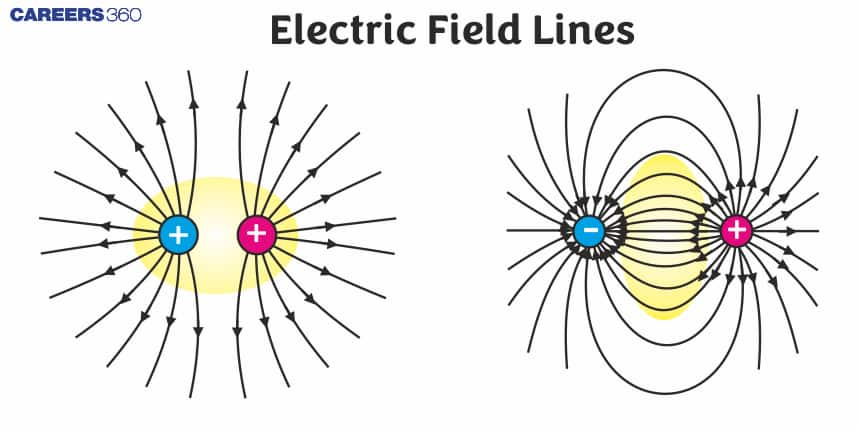
They are denser where the field is stronger.
C. ELECTRIC POTENTIAL (V)
Electric potential at a point is defined as the work done per unit charge in bringing a positive test charge from infinity to that point in an electric field.
V = W / q
For a point charge Q at distance r:
V = kQ / r = Q / (4πε₀ r)
Unit: Volt (V) or Joule per Coulomb (J/C)
It is a scalar quantity.
Potential Difference (p.d): Work done per unit charge in moving a charge from one point to another.
V(AB) = V(A) − V(B) = W(AB) / q
Relationship between E and V:
E = V/d, where d is the distance between two equipotential surfaces. Therefore, V = E × d.
Example: What is the potential at a distance of 0.3 m from a charge of 2 × 10⁻⁶ C?
V = (9 × 10⁹ × 2 × 10⁻⁶) = 60,000 V
0.3
Summary Table
| Quantity | Formula | Unit | Type |
|---|---|---|---|
| Force | F = kq₁q₂/r² | Newton (N) | Vector |
| Field Intensity | E = F/q | N/C or V/m | Vector |
| Potential | V = W/q | Volt (V) | Scalar |
Evaluation
OBJECTIVE QUESTIONS
The force between two point charges is directly proportional to:
Distance between them
Square of distance
Product of the charges
Sum of the charges
The value of k = 1/(4πε₀) in vacuum is:
9 × 10⁹ Nm²/C²
9 × 10⁻⁹ Nm²/C²
8.85 × 10⁻¹² F/m
1.6 × 10⁻¹⁹ C
Electric field intensity is defined as:
Work per unit charge
Force per unit charge
Potential per unit distance
Charge per unit area
The S.I unit of electric field intensity is:
Volt
Joule
N/C or V/m
Coulomb
Electric potential is a
Vector quantity
Scalar quantity
Both scalar and vector
Dimensionless quantity
The electric potential at a distance r from a point charge Q is given by:
V = kQ/r²
V = kQ/r
V = kq₁q₂/r²
V = E × r²
Electric field lines:
Cross each other at the neutral point
Start from negative and end on positive
Never intersect
Form closed loops
If the distance between two charges is doubled, the force between them will be:
Doubled
Halved
One-fourth
Four times
The relationship between electric field intensity € and potential difference (V) is:
E = V × d
E = V/d
E = V/d²
E = W/q
The work done in bringing a charge of 2 C from infinity to a point with potential 10 V is:
5 J
10 J
20 J
0.2 J
PART B: THEORY QUESTIONS
1a. State Coulomb’s law and write down its mathematical expression, defining all terms.
1b. Two-point charges of +3 µC and +4 µC are placed 0.6 m apart in vacuum. Calculate the force between them and state whether it is attractive or repulsive. [k = 9 × 10⁹ Nm²/C²]
2a. Define (i) Electric field intensity (ii) Electric potential at a point.
2b. With the aid of a diagram, show the electric field pattern for (i) an isolated positive charge (ii) two opposite charges.
2c. A charge of 5 × 10⁻⁸ C is placed in an electric field of intensity 2 × 10⁵ N/C. What is the force experienced by the charge?