
INTRODUCTION TO LASER Lesson Note
This SS3 Physics lesson note covers INTRODUCTION TO LASER for First Term, Week 1.
Learning Objectives
- By the end of the lesson, students should be able to:
- 1. define laser and explain the meaning of the acronym LASER;
- 2. list and explain the basic components/types of laser;
- 3. state the characteristics (properties) of laser light;
- 4. enumerate the advantages and disadvantages of laser;
Lesson Note
BASIC STRUCTURE OF A LASER
The diagram below shows the major parts of a simple laser device:
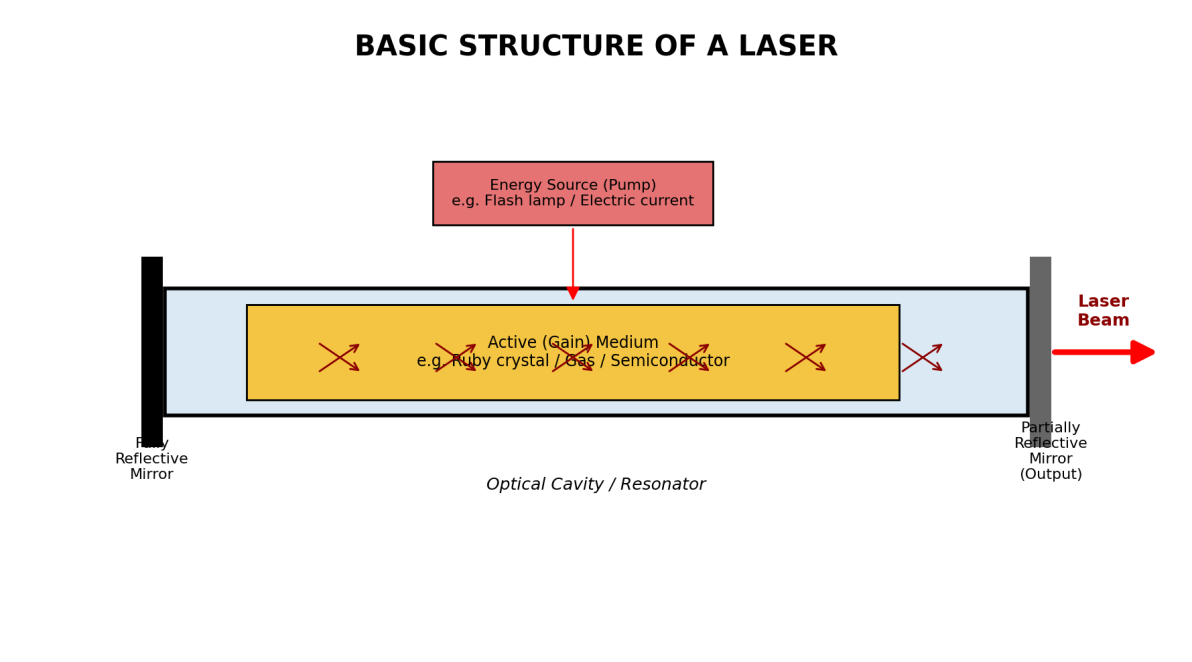
Explanation of the parts:
● Energy Source (Pump): Supplies energy (e.g. from a flash lamp or electric current) to excite the atoms in the active medium.
● Active (Gain) Medium: The material (solid, liquid, gas, or semiconductor) in which atoms are excited to produce light — e.g. ruby crystal, helium-neon gas, or semiconductor material.
● Fully Reflective Mirror: A mirror at one end of the tube that reflects all the light back into the cavity.
● Partially Reflective Mirror: A mirror at the other end that reflects most of the light back but allows a small portion (the laser beam) to pass out as the output.
● Optical Cavity (Resonator): The space between the two mirrors where the light bounces back and forth, gaining strength (amplification) before it is emitted.
INTRODUCTION TO LASER
MEANING OF LASER
Laser stands for “Light Amplification by Stimulated Emission or Radiation”. It is a device that makes atoms or electron give off electromagnetic radiation. This radiation has a specific wavelength and is then made stronger, producing a narrow range of light unlike other types of light, the light from a laser has the same frequencies a wavelength making a narrow beam of light, beams of light is produced. The branch of optical physics lays the foundation of quantum electrons. “The laser beams have a property similar to that light wave emitted all at once.
They are coherent and usually of one wavelength or color. A laser is a device that increases the intensity of light by focusing in a particular direction. Some laser produces visible light and some produce ultraviolet or infarred rays.
CHARACTERISTICS (PROPERTIES) OF LASER LIGHT
Laser light differs from ordinary light because of the following special properties:
● Monochromatic : Laser light consists of only one wavelength (one colour), unlike ordinary light which is a mixture of many wavelengths. A light beam which contains a single wavelength photon that’s originate from natural light sources contains a range of emerges wavelength and colour
● Coherence: Visible light receives its emission from excited electrons[electron of the higher energy level] are move down to the lower energy level [ground state]
● Directionality : In conventional light source like lamps, torch light, electric bulbs e.t.c photons move at random point. As such these source scatter, light in all possible directions. The laser emit light in a particular focused direction.
● High Intensity (Brightness): Because the light energy is concentrated in a narrow beam, laser light is far more intense and powerful than ordinary light of the same energy. The light of a laser is focused in a particular direction.
LASER TYPES AND USES
There are many types of lasers and they are categories based on the type of medium at which they are used. This can be Solid, Liquid, Gas and Semi-conductors.
1. SOLID STATE: These lasers are made up of solid media like ruby or crystalline. The laser has a flash tube wrapped around it to excite the electron.
These types of lasers are typically used for the target destination system by military application.
2. GAS LASER: These types of lasers are made of helium, neon and produces characteristics of red laser light. They are powerful and efficient and also use for industrial cutting and welding application.
3. LIQUID DYES LASER: The liquid dye laser like sodium fluorescence, rhodamine B and rhodamine in a liquid solution as their medium. In this laser, the electron is excited either by an arc lamp, flash lamp or another laser. Liquid dyes laser can produce a broader band of light frequencies as compared to solid state or liquid laser and are used in a variety of application. These lasers are commonly used for medical purpose as a research tool.
4. SEMI-CONDUCTOR LASER: These types of lasers are very cheap to produce and hence found in several electronic devices like laser printer and bar code scanner. These are also called diode laser, as they use LED’S to generate light in a monochromatic pattern.
N.B. These are other type of laser and they include chemical laser and metal vapour laser.
E. ADVANTAGES OF LASER
● It is used in medicine for delicate surgeries (e.g. eye surgery, removal of tumors) with high precision and minimal damage to surrounding tissue.
● It is used in industry for cutting, welding, drilling and engraving hard materials with high accuracy.
● It is used in communication (fibre optics) to transmit large amounts of information over long distances quickly and with little loss.
● It is used in barcode scanners and laser printers in commerce and offices, making work faster and more accurate.
● It is used in scientific research and measurement, e.g. measuring long distances (surveying) and in laboratories.
● It is used in military applications, such as laser-guided weapons and range finders.
● It is used in entertainment, for laser light shows and in optical devices like CD/DVD players.
F. DISADVANTAGES OF LASER
● It can cause serious and permanent eye damage (blindness) if the beam enters the eye directly, since it can burn the retina.
● It can cause skin burns when high-power laser beams come in contact with the skin.
● It can start a fire if directed at flammable (combustible) materials, due to its concentrated energy.
● Laser equipment and its maintenance are generally expensive.
● It can be misused as a weapon or for harmful purposes if it falls into the wrong hands.
● Some laser devices require highly trained/skilled personnel to operate safely, which may not always be readily available
G. SUMMARY / CONCLUSION
A laser is a device that produces a highly concentrated, monochromatic, coherent and directional beam of light through the process of light amplification by stimulated emission of radiation. Lasers exist in different types depending on their active medium — solid, gas, liquid, and semiconductor. While lasers have numerous advantages in medicine, industry, communication and research, they must be handled with care because of their potential to cause eye damage, skin burns, and fire outbreaks.
Evaluation
SECTION A: OBJECTIVE QUESTIONS
1. LASER is an acronym for _____.
(a) Light Amplification by Stimulated Emission of Radiation
(b) Light Analysis by Sound Emission of Radiation
(c) Line Amplification by Stimulated Energy of Radiation
(d) Light Amplification by Standard Emission of Rays
2. Which of these is NOT a property of laser light?
(a) Monochromatic
(b) Coherent
(c) Divergent
(d) Highly directional
3. The material in which atoms are excited to produce laser light is called the _____.
(a) resonator
(b) active medium
(c) pump source
(d) collimator
4. A laser that uses Helium and Neon gases as its active medium is an example of a _____ laser. (a) solid-state
(b) gas
(c) liquid
(d) semiconductor
5. Laser light travels in _____.
(a) all directions
(b) a single narrow beam
(c) a scattered pattern
(d) random directions
6. The mirror that allows a small portion of light to leave the laser tube as the output beam is the _____ mirror.
(a) fully reflective
(b) partially reflective
(c) concave
(d) convex
7. Which of the following is a common application of laser in offices?
(a) Laser printer
(b) Water pump
(c) Electric kettle
(d) Refrigerator
8. Laser light waves that rise and fall together in step are said to be _____.
(a) diffracted
(b) coherent
(c) refracted
(d) polarised
9. A major danger associated with laser is that it can cause _____.
(a) improved eyesight
(b) eye damage
(c) better hearing
(d) stronger bones
10. Which type of laser is commonly used in laser pointers and barcode scanners?
(a) Gas laser
(b) Dye laser
(c) Semiconductor (diode) laser
(d) Excimer laser
Theory Questions
1. (a) What does the acronym LASER stand for? (b) State three (3) characteristics of laser light.
2. With the aid of a well-labelled diagram, describe the basic structure of a laser and briefly explain how a laser beam is produced.