
THE PERIPHERAL NERVOUS SYSTEM AND THE NEURONE Lesson Note
Learning Objectives
This SS3 Biology lesson note covers THE PERIPHERAL NERVOUS SYSTEM AND THE NEURONE for First Term, Week 5.
Lesson Note
Learning Objectives
By the end of the lesson, students should be able to:
Define the peripheral nervous system.
Identify the major components of the peripheral nervous system.
Explain the functions of the peripheral nervous system.
Define a neurone.
Describe the structure of a neurone.
Identify the different types of neurones.
Explain how nerve impulses are transmitted.
State the importance of the myelin sheath and synapse.
A. MEANING OF THE PERIPHERAL NERVOUS SYSTEM
The Peripheral Nervous System (PNS) is the part of the nervous system made up of all the nerves and nerve structures located outside the brain and spinal cord.
The PNS connects the central nervous system (CNS)—the brain and spinal cord—to different parts of the body.
B. MAIN FUNCTIONS OF THE PNS
The peripheral nervous system:
1. Carries information from sense organs to the brain and spinal cord.
2. Carries instructions from the brain and spinal cord to muscles and glands.
3. Helps the body respond to changes in its environment.
4. Coordinates communication between the CNS and the rest of the body.
C. COMPONENTS OF THE PERIPHERAL NERVOUS SYSTEM
The PNS consists mainly of:
1. Cranial Nerves
These are nerves that arise directly from the brain.
They carry impulses between the brain and parts of the head, neck and some internal organs.
2. Spinal Nerves
These arise from the spinal cord.
They carry sensory and motor impulses between the spinal cord and different parts of the body.
D. DIVISIONS OF THE PERIPHERAL NERVOUS SYSTEM
The PNS can be divided functionally into:
1. Somatic Nervous System
The somatic nervous system controls activities that are mainly under conscious or voluntary control.
Examples include: Walking, Writing, Running, Moving the hand and Kicking a ball
It carries sensory information to the CNS and motor instructions to skeletal muscles.
2. Autonomic Nervous System
The autonomic nervous system controls many activities that occur automatically or involuntarily.
Examples include: Heartbeat, Digestion, Regulation of blood vessels, Activity of some glands and Movement of food through the digestive tract
The autonomic nervous system is commonly divided into:
1. Sympathetic nervous system – prepares the body for situations requiring increased activity, such as during fear, stress or exercise.
2. Parasympathetic nervous system – generally promotes rest, digestion and recovery after activity.
E. THE NEURONE
A neurone (nerve cell) is a specialized cell that receives, conducts and transmits electrical nerve impulses from one part of the nervous system to another.
Neurones are the basic functional units of the nervous system.
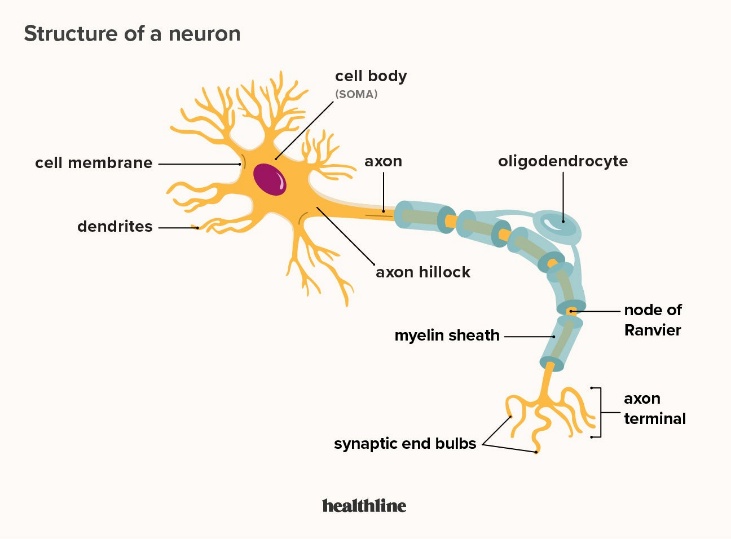
F. Structure of a Neurone
A typical neurone consists of the following parts:
1. Cell Body
The cell body contains the: Nucleus, Cytoplasm and Other cell organelles
It controls the activities of the neurone and maintains its life.
2. Dendrites
Dendrites are short, branched extensions from the cell body.
Function: They receive impulses from receptors or other neurones and conduct them towards the cell body.
3. Axon
The axon is a long fibre that carries nerve impulses away from the cell body.
Some axons can be very long, allowing impulses to travel over considerable distances within the body.
4. Myelin Sheath
The myelin sheath is a fatty insulating covering around many axons.
Functions:
1. Protects the axon.
2. Insulates the nerve fibre.
3. Helps nerve impulses travel more rapidly.
5. Nodes of Ranvier
These are small gaps between sections of the myelin sheath.
They help impulses travel rapidly along myelinated nerve fibres.
6. Axon Terminals
These are branches at the end of the axon. They form connections with other neurones, muscles or glands and help transmit signals to the next cell.
G. TYPES OF NEURONES
There are three major types of neurones:
1. Sensory Neurone
A sensory neurone carries nerve impulses from receptors or sense organs to the CNS.
Example:
When a person touches a hot object, sensory receptors detect the stimulus and sensory neurones carry the information towards the CNS.
2. Relay Neurone
A relay neurone, also called an interneurone, is found mainly within the CNS.
It connects sensory neurones with motor neurones and helps process information.
3. Motor Neurone
A motor neurone carries impulses from the CNS to an effector, such as a muscle or gland.
For example, motor neurones carry instructions to muscles to produce movement.
H. DIRECTION OF NERVE IMPULSE
The general pathway of a nervous response can be represented as:
Stimulus → Receptor → Sensory neurone → Relay neurone → Motor neurone → Effector → Response
For example, when the hand comes into contact with a hot object:
Heat → Receptor → Sensory neurone → CNS → Motor neurone → Arm muscles → Withdrawal of hand
I. SYNAPSE
A synapse is the junction or tiny gap between two neurones or between a neurone and an effector.
At a synapse, the nerve impulse causes the release of chemical neurotransmitters. These chemicals cross the small gap and stimulate the next neurone or effector.
J. IMPORTANCE OF SYNAPSES
1. They allow communication between neurones.
2. They help ensure that impulses generally travel in one direction.
3. They help the nervous system coordinate appropriate responses.
K. Receptors and Effectors
Receptors
Receptors are specialized cells or nerve endings that detect changes called stimuli.
Examples include receptors for: Light, Sound, Temperature, Pressure, Touch and Chemicals
Effectors
Effectors are organs that carry out a response. The main effectors are:
*Muscles, which contract.
*Glands, which secrete substances.
L. IMPORTANCE OF THE PERIPHERAL NERVOUS SYSTEM
The PNS is important because it:
Connects the brain and spinal cord to the rest of the body.
Carries sensory information to the CNS.
Carries motor commands from the CNS.
Helps coordinate voluntary movements.
Helps control involuntary activities.
Enables the body to respond to environmental changes.
Helps maintain communication between different body organs and the nervous system.
SUMMARY
The peripheral nervous system (PNS) consists mainly of nerves outside the brain and spinal cord. It includes the cranial and spinal nerves and connects the CNS with the rest of the body. Functionally, it is divided into the somatic and autonomic nervous systems.
A neurone Is a specialized nerve cell that transmits nerve impulses. The major types are sensory, relay and motor neurones. Important structures include the cell body, dendrites, axon, myelin sheath, nodes of Ranvier and axon terminals. Neurones communicate with one another through synapses.
Evaluation
OBJECTIVE QUESTIONS
1. The peripheral nervous system consists mainly of nerves located ________.
A. inside the brain only
B. outside the brain and spinal cord
C. inside the spinal cord only
D. inside the skull only
2. Which of the following nerves arises directly from the brain?
A. Spinal nerve
B. Cranial nerve
C. Motor nerve
D. Relay nerve
3. The basic functional unit of the nervous system is the ________.
A. nephron
B. neurone
C. alveolus
D. hormone
4. Which part of a neurone mainly receives impulses?
A. Dendrite
B. Axon
C. Myelin sheath
D. Axon terminal
5. The main function of the myelin sheath is to ________.
A. produce hormones
B. digest food
C. insulate the axon and increase impulse transmission speed
D. produce blood cells
6. Which type of neurone carries impulses from receptors to the CNS?
A. Motor neurone
B. Relay neurone
C. Sensory neurone
D. Secretory neurone
7. A relay neurone is mainly found in the ________.
A. skin
B. CNS
C. muscles
D. glands
8. Which of the following carries impulses from the CNS to an effector?
A. Sensory neurone
B. Motor neurone
C. Relay neurone
D. Receptor
9. The junction between two neurones is called a ________.
A. node
B. synapse
C. receptor
D. cell body
10. Which division of the peripheral nervous system is mainly associated with voluntary control of skeletal muscles?
A. Autonomic nervous system
B. Somatic nervous system
C. Endocrine system
D. Sympathetic nervous system
THEORY QUESTIONS
1a. What is the peripheral nervous system? State four functions of the PNS.
1b. Describe the structure of a typical neurone and state the functions of its major parts.
2a. Differentiate between sensory, relay and motor neurones.
2b. Explain the roles of the somatic and autonomic nervous systems.
2c. Describe how a nerve impulse can travel from a receptor to an effector during a response to a stimulus.