
Newton's Laws of Motion Lesson Note
Sub-Topic: Conservation of Linear Momentum, Conservation of Energy & Collisions
This SS2 Physics lesson note covers Newton's Laws of Motion for First Term, Week 5.
Lesson Note
Sub-Topic: Conservation of Linear Momentum, Conservation of Energy & Collisions
Learning Objectives: At the end, students should be able to:
State Newton's 3 laws of motion
Define linear momentum
State and apply principle of conservation of linear momentum
Define collision and explain types
Solve problems on collisions
CONTENT
NEWTON'S LAWS OF MOTION
First Law (Law of Inertia): A body continues in its state of rest or uniform motion in a straight line unless acted upon by an external force.
Second Law: Rate of change of momentum is proportional to applied force and occurs in direction of force.
F = ma
Third Law: Action and reaction are equal and opposite. For every action there is equal and opposite reaction.
LINEAR MOMENTUM
Linear momentum (p) is defined as the product of mass and velocity.
p = m × v
Unit: kgm/s or Ns. Momentum is a vector quantity.
PRINCIPLE OF CONSERVATION OF LINEAR MOMENTUM
This principle is derived from Newton's 3rd Law.
Statement: In a closed system (no external force), the total momentum before collision is equal to the total momentum after collision.
For two bodies colliding:
m₁u₁ + m₂u₂ = m₁v₁ + m₂v₂
Where:
m₁, m₂ = masses
u₁, u₂ = initial velocities before collision
v₁, v₂ = final velocities after collision
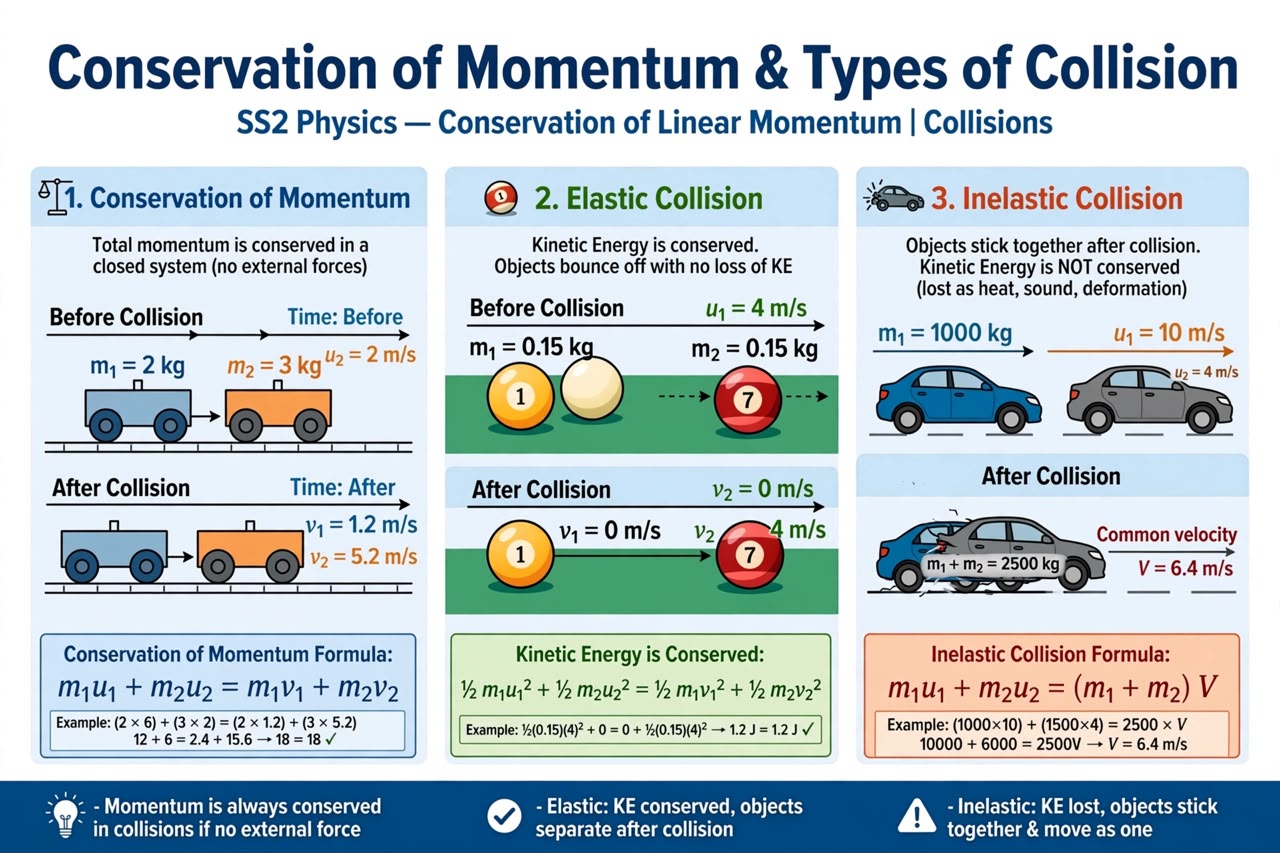
Diagram: Shows two trolleys. Total momentum before = 18 kgm/s, total after = 18 kgm/s. Momentum is conserved.
Applications of Conservation of Momentum:
Recoil of a gun
Rocket propulsion
Jet engine
Collision of billiard balls
Example: A gun of mass 4 kg fires a bullet of mass 0.05 kg with velocity 300 m/s. Find the recoil velocity of the gun.
m_g v_g = m_b v_b
4 × v_g = 0.05 × 300
v_g = 15/4 = 3.75 m/s backwards
CONSERVATION OF ENERGY IN COLLISION
Law of Conservation of Energy: Energy can neither be created nor destroyed but can be changed from one form to another.
In any collision, total energy is conserved but kinetic energy may not be conserved.
COLLISION
Collision is the coming together of two or more bodies, during which they exert force on each other for a short time.
Types of Collision:
A. ELASTIC COLLISION
A collision in which both momentum and kinetic energy are conserved. Bodies separate after collision, with no loss of energy.
Examples: Billiard balls, gas molecules
Equations:
Momentum: m₁u₁ + m₂u₂ = m₁v₁ + m₂v₂
Kinetic Energy: ½m₁u₁² + ½m₂u₂² = ½m₁v₁² + ½m₂v₂²
See Diagram 2 in chart: White ball hits red ball. White stops, red moves with same speed. Energy conserved: 1.2 J before = 1.2 J after.
B. INELASTIC COLLISION
A collision in which momentum is conserved but kinetic energy is NOT conserved. Some kinetic energy is lost as heat, sound, deformation. Bodies may stick together.
Examples: Car crash, bullet hitting wood, two lumps of plasticine sticking together
Equation (if they stick together – perfectly inelastic):
m₁u₁ + m₂u₂ = (m₁ + m₂)V
Where V = common velocity
See Diagram 3 in chart: Two cars collide and stick. Momentum conserved but KE lost.
Example of Inelastic: A car of mass 1000 kg moving at 10 m/s collides with another car of mass 1500 kg moving at 4 m/s in the same direction and they stick. Find the common velocity.
1000 × 10 + 1500 × 4 = 2500 × V
10000 + 6000 = 2500V
V = 16000/2500 = 6.4 m/s
Differences:
| Feature | Elastic | Inelastic |
|---|---|---|
| Kinetic energy | KE conserved | KE not conserved |
| After collision | Objects separate | Objects may stick together |
| Energy loss | No sound/heat loss | Sound, heat, deformation occurs |
Full Illustration Chart:
[Insert illustration chart (Diagrams 1–3) here]
GENERAL SUMMARY OF THE LESSON
Newton's Laws govern all motions. First Law talks about inertia, Second about F = ma, Third about action-reaction which leads to conservation of momentum.
Linear Momentum p = mv is always conserved in a closed system.
Conservation Formula: m₁u₁ + m₂u₂ = m₁v₁ + m₂v₂ is always true for all collisions if there is no external force.
Energy: Total energy is always conserved but Kinetic Energy is only conserved in elastic collision.
Elastic Collision: Both momentum and KE conserved. Objects bounce apart, e.g. billiard balls. Formula uses ½mv² conservation.
Inelastic Collision: Only momentum conserved. KE is lost as heat/sound. Objects may stick together with common velocity V. Formula: m₁u₁ + m₂u₂ = (m₁ + m₂)V
In real life, most collisions are partially inelastic (some KE lost).
Evaluation
OBJECTIVE QUESTIONS
1. Newton's first law is also called:
A) Law of acceleration
B) Law of inertia
C) Law of momentum
D) Law of gravity
2. Linear momentum is defined as:
A) m/a
B) m × v
C) F × t
D) m/v
3. The SI unit of linear momentum is:
A) kgm/s²
B) kgm/s
C) Joule
D) Watt
4. The principle of conservation of linear momentum states that in a closed system:
A) Total energy is zero
B) Total momentum before = Total momentum after
C) Velocity is constant
D) Mass is lost
5. A gun recoils when a bullet is fired. This is an application of:
A) First law
B) Conservation of momentum from 3rd law
C) Second law only
D) Law of gravity
6. In an elastic collision:
A) Only momentum is conserved
B) Only kinetic energy is conserved
C) Both momentum and kinetic energy are conserved
D) Neither is conserved
7. In a perfectly inelastic collision, the colliding bodies:
A) Separate with same velocity
B) Stick together and move with common velocity
C) Explode
D) Come to rest
8. The formula m₁u₁ + m₂u₂ = (m₁ + m₂)V is used for:
A) Elastic collision
B) Perfectly inelastic collision
C) No collision
D) Circular motion
9. When two billiard balls collide and move apart, kinetic energy lost as heat/sound is:
A) Very large
B) Zero
C) Maximum
D) Half
10. Two cars of masses 1000 kg and 1500 kg moving at 10 m/s and 4 m/s collide and stick. Their common velocity is:
A) 2.4 m/s
B) 14 m/s
C) 6.4 m/s
D) 10 m/s
THEORY QUESTIONS
1. (a) State Newton's three laws of motion. [3 marks]
(b) State the principle of conservation of linear momentum and write the equation for two bodies colliding
(c) Define collision and differentiate between elastic and inelastic collision with 2 differences and 1 example each
(d) A gun of mass 5 kg fires a bullet of mass 0.02 kg with velocity 400 m/s. Calculate the recoil velocity of the gun
2. (a) With the aid of diagrams, explain what happens in (i) Elastic collision (ii) Inelastic collision
(b) A car of mass 1000 kg moving with velocity 10 m/s collides with a stationary car of mass 1500 kg. If they stick together after collision, calculate:
(i) Common velocity V
(ii) Initial kinetic energy before collision
(iii) Final kinetic energy after collision
(iv) Energy lost