
CONCEPT OF POSITION Lesson Note
This SS2 Physics lesson note covers CONCEPT OF POSITION for First Term, Week 1.
Learning Objectives
- By the end of the lesson, student be able to
- Define position and reference point
- Define distance and displacement
- Distinguish between distance and displacement with examples
- Calculate distance and displacement in simple problems
- State the SI unit and nature (scalar/vector) of each
Lesson Note
A. INTRODUCTION
Every motion starts from somewhere. To describe where an object is, we need a reference point. If you say "I am in the market", it's not clear unless you say where the market is from your house.
B. MEANING
POSITION
Position is a point space, is determine by its distance and direction from other point. Position is a location of point using rectangular coordinates X and Y axis. It is a vector quantity. We measure position along a straight line as x. If an object is at point A, its position is x1 from origin. If it moves to B, its new position is x2.
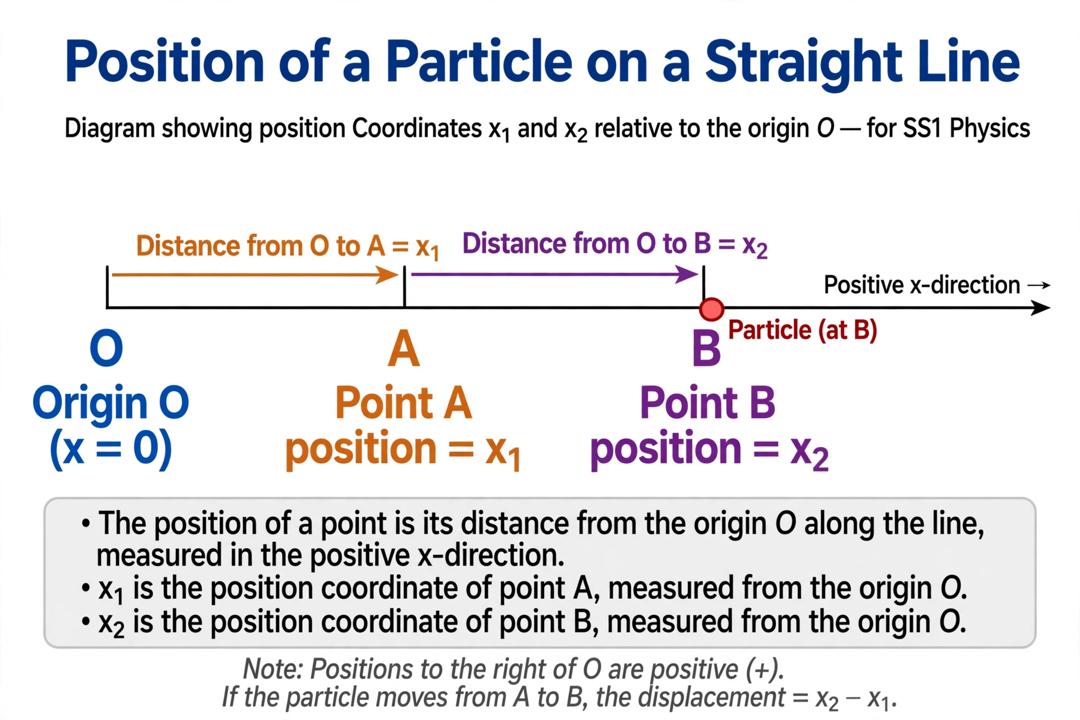
Displacement in moving from A to B is: Displacement = Final Position - Initial
DISTANCE
Distance is the product of average speed an time. It can also be defined as the length of space covered by an object when it changes point from one point to another.
Example: If you walk 3m east, then 4m west following a winding path, your distance is 3+4 = 7m.
It is a scalar quantity ( only magnitude, no direction)
It can never be zero or negative, always positive
SI unit is metre (m)
It depends on the path taken.
DISPLACEMENT
Displacement is the distance moved in a specified direction. It is the straight-line distance between initial and final positions in a stated direction.
It is a vector quantity (has both magnitude and direction)
It can be zero, positive or negative
SI unit is metre (m)
It does NOT depend on path, only on start and finish
Example: If you walk 3m east, then 4m west, your displacement is -1m or 1m West from start. If you return to your starting point, displacement = 0 even though distance is not zero.
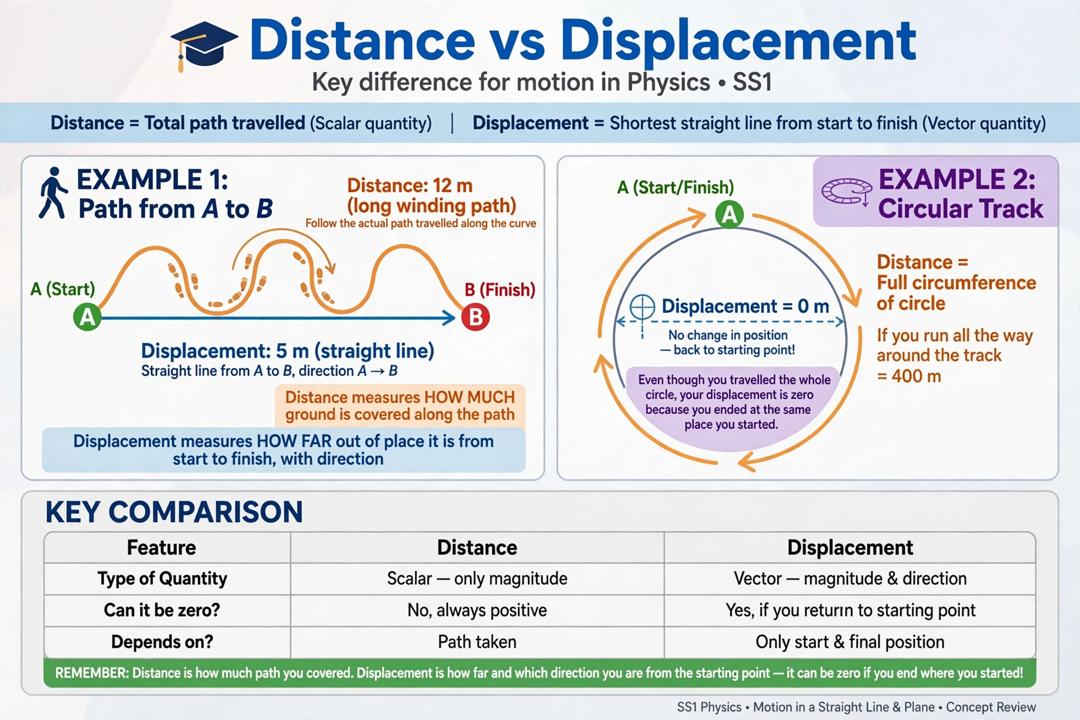
C. DIFFERENCES BETWEEN DISTANCE AND DISPLACEMENT
| Distance is a scalar quantity | Displacement is a vector quantity |
|---|---|
| Distance is denoted as S | Displacement is donated as X |
| 3 Is the product of speed and time | Is is the product of velocity and time |
| 4 SI unit is metre(m) | SI unit is kilometre (km) |
WORKED EXAMPLES
1. A boy walks 4km North and then 3km East. Find a) Distance b) Displacement.
a) Distance = 4+3 = 7km
b) Displacement = resultant using Pythagoras
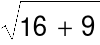
Hyp2 = Opp2 + Adj2
Hyp2 = = 5km North-East
2. An athlete runs one complete lap on a 400m circular track.

Distance = 400m, Displacement = 0m (since he returned to start)
D. DISTANCE BETWEEN TWO CO-ORDINATES
The position of any point such as P is determined and specified by two quantities known as the coordinate. The x-coordinate and the y-coordinate respectively. If we say that the coordinate of a point P, are (x1, y1) we mean that the distance P from O in the X-direction is x1 and y1, in the Y-direction sometimes the x-coordinate is called abscissa and y-coordinate is called the ordinate. The straight joining PQ is distance.
Evaluation
OBJECTIVE QUESTIONS (10)
1. The location of a body with respect to a fixed point is called...
A) Distance
B) Displacement
C) Position
D) Speed
2. Which of the following is a vector quantity?
A) Distance
B) Displacement
C) Mass
D) Time
3. The SI unit of distance and displacement is...
A) Kilometre
B) Centimetre
C) Metre
D) Second
4. A man treks 5m east and 5m west and stops. His displacement is...
A) 10m
B) 5m
C) 0m
D) 2.5m
5. Distance is scalar because it has...
A) Only magnitude
B) Only direction
C) Both magnitude and direction
D) No magnitude
6. An object moves from x = 2m to x = 10m. Its displacement is...
A) 8m
B) 12m
C) 2m
D) - 8m
7. Which can be zero when a body is in motion?
A) Distance
B) Displacement
C) Both
D) None
8. The total path covered irrespective of direction is...
A) Position
B) Distance
C) Displacement
D) Reference point
9. If a car travels 100km and returns to its starting point, its displacement is...
A) 100km
B) 200km
C) 0km D
) 50km
10. Displacement is ------
Theory Questions
1. a) Define position and reference point with a diagram.
b) A girl walks from her home (position 0m) to a shop at 200m, then back 50m towards home to buy pure water. Calculate: i) Her total distance covered ii) Her displacement from home. Explain why the two answers are different.
2. a) With the aid of a diagram, clearly distinguish between distance and displacement. Give two differences between them.
b) An object moves from x1 = -2m to x2 = 6m along a straight line. What is its displacement? Is it positive or negative? What does the sign indicate?