
SCALAR AN VECTOR QUANTITIES Lesson Note
LEARNING OBJECTIVES: By the end of the class, students should be able to :
This SS2 Physics lesson note covers SCALAR AN VECTOR QUANTITIES for First Term, Week 2.
Lesson Note
LEARNING OBJECTIVES: By the end of the class, students should be able to :
Define scalar an vector quantities
Give example of each
Differentiate between scalar and vector
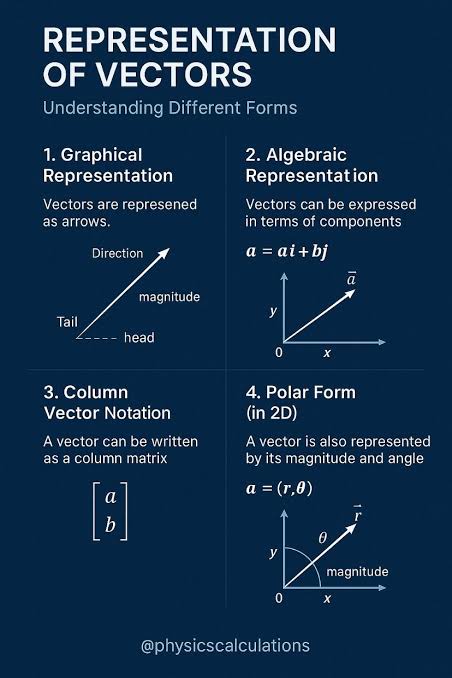
Representation of vector
DEFINITION:
SCALAR QUANTITIES: A scalar quantity is one which has only magnitude. Examples are distance, speed, Temperature, Volume, Mass etc.
VECTOR QUANTITIES: A vector quantity is one which has both magnitude and direction. Example include: displacement, velocity, weight, force, acceleration etc.
Scalar can be added and subtracted easily by using ordinary algebra. While vector involve mathematical calculation using vector diagram.
REPRESENTATION OF A VECTOR
Vector representative may be referred to as a way of representing vector either graphically or analytically
PARALLELOGRAM LAW OF VECTOR
The states that if two vectors acting at a point are represented in magnitude and direction by two adjacent sides of a parallelogram starting from the same point, their resultant vector is represented by the diagonal passing through that same point
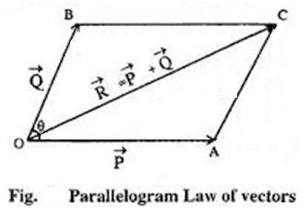
Parallelogram law of vector
In ACD
AC2 = OB2 + OA2 + 2(OB)(OA) cos(180-)
N:B = cos(180-) = -cos
Where 0<<90
Worked Example: Find by the means of vector diagram he resultant of two force of 7N and 3N acting perpendicular
B
7N
A 3N O
|OB|2 = |AB|2 + |OA|2
|OB|2 = |7|2 + |3|2
|OB|2 = 49 + 9 = 58
tanθ = 7/3.
= 7/3 66.8
+ + 90 = 180
66.8 + + 90 = 180
∝= 180-156.8
= 23.19
Example: Solve this using resolution into component forces. To find the resultant of more than two vector, we resolve each vector of more perpendicular direction. Add all the horizontal component X, an all the vertical component Y. For example
F2 F1
2
3 4
F4 F3
X = F1cos 1 +(-F2cos 2) + (-F3cos 3) + F4cos 4
Y = F1sin1 + F2sin 2 + F3cos 3 + F4cos 4
R2 = X2 + Y2
Evaluation
OBJECTIVE QUESTIONS:
A physical quantity with magnitude only is called
Vector
B. Scalar
C. Resultant
D. Units
Which of these is a scalar quantity
A. Force
B. Velocity
C. Mass
D. Displacement
Which of these is a vector quantity?
A. Speed
B. Time
C. Distance
D. Weight
Distance is a scalar while displacement is a
A. Scalar
B. Vector
C. Both
D. None
A vector is represented by:
A. A line only
B. A line with arrow
C. A dot
D. A circle
The single vector that has same effect as two or more vectors is called:
A. Equilibrant
B. Unit vector
C. Resultant
D. Zero vector
If two vectors act in same direction ( = 0), resultant R is
A. P-Q
B. P+Q
C.P2 +Q2
D. Zero
A force of 10N gives resultant of:
A. 20N
B. 10N
C. 14N
D. 0N
Breaking a vector into component is called:
A. Addition
B. Resolution
C. Composition
D. Multiplication.
If F = 100N at 30 to x-axis, Fx =?
A. Fsin
B. Fcos
C. F Tan
D. F/cos
Theory Questions
1a. Define scalar and vector quantities and give 4 example each.
Two forces of 6N and 8N act perpendicular to each other at a point. Calculate the magnitude and direction of their resultant.
2a. Explain with diagram Parallelogram law of vector
b. A boy pull a load with a force of 80N at an angle of 60 to the horizontal. Calculate:
I. Effective force pulling the load forward (horizontal)
Ii. Effect force lifting the load (vertical)