
RESPIRATORY SYSTEM Lesson Note
Learning Objectives
This SS2 Biology lesson note covers RESPIRATORY SYSTEM for First Term, Week 5.
Lesson Note
Learning Objectives
By the end of the lesson, students should be able to:
Define respiration and breathing.
Explain the meaning of the respiratory system.
Identify the major organs of the human respiratory system.
State the functions of the different respiratory organs.
Explain the mechanism of breathing in humans.
Describe gaseous exchange in the lungs.
State the features that make the alveoli suitable for gaseous exchange.
Differentiate between breathing and cellular respiration.
State common respiratory diseases and their effects.
Explain how the respiratory system can be kept healthy.
A. MEANING OF RESPIRATION
Respiration is the process by which energy is released from food substances in living cells.
There are two main types:
Aerobic respiration – takes place in the presence of oxygen.
Aerobic respiration can be represented as:
Glucose + Oxygen → Carbon dioxide + Water + Energy
Anaerobic respiration – takes place without oxygen.
B. MEANING OF BREATHING
Breathing is the physical process of taking air into the lungs and removing air from the lungs.
It involves two processes:
Inhalation (inspiration) – taking air into the lungs.
Exhalation (expiration) – removing air from the lungs.
C. Difference between Breathing and Respiration
Breathing Respiration
Physical process Chemical process
Involves movement of air in and Involves breakdown of food to release
out of the lungs energy
Occurs mainly in the respiratory organs Occurs in living cells
Does not directly release energy Releases energy
Involves inhalation and exhalation May be aerobic or anaerobic
D. THE HUMAN RESPIRATORY SYSTEM
The human respiratory system is the group of organs involved in breathing and gaseous exchange.
The major parts include:
Nose and nasal cavity
Pharynx
Larynx
Trachea
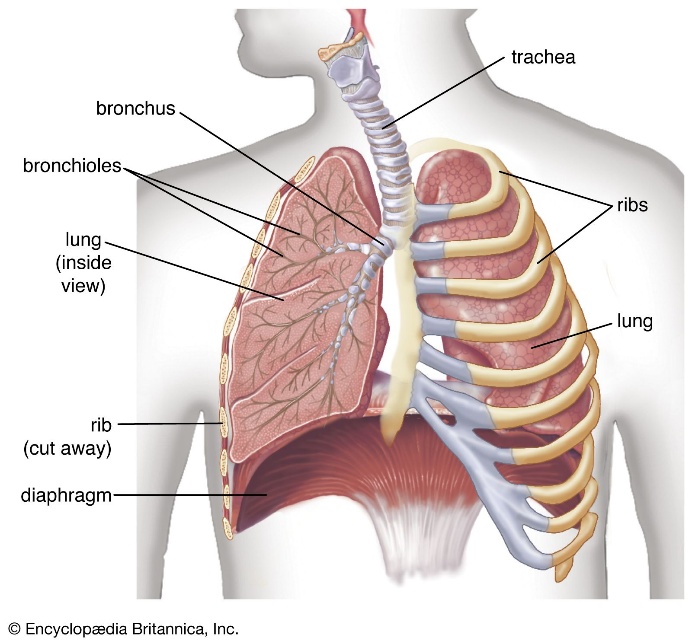
Bronchi
Bronchioles
Lungs
Alveoli
Diaphragm
Intercostal muscles
Air pathway:
Nose → Pharynx → Larynx → Trachea → Bronchi → Bronchioles → Alveoli
1. NOSE AND NASAL CAVITY
The nose is the main entrance through which air enters the respiratory system.
The nasal cavity contains hairs and mucus.
Functions
a. Filters dust and other particles from incoming air.
b. Mucus traps dust and microorganisms.
c. Warms incoming air.
d. Moistens the air.
e. Contains receptors involved in the sense of smell.
2. PHARYNX
The pharynx is a passage that connects the nasal cavity and mouth to the larynx and oesophagus.
It serves as a common passage for air and food, although they are directed into different pathways.
3. Larynx
The larynx, commonly called the voice box, is located between the pharynx and trachea.
Functions
a. Provides a passage for air.
b. Contains the vocal cords used in sound production.
c. Helps prevent food from entering the trachea during swallowing.
4. Trachea
The trachea, or windpipe, is a tube that carries air from the larynx towards the bronchi.
Its walls contain C-shaped rings of cartilage that help prevent the airway from collapsing.
The inner lining produces mucus and has cilia that help move trapped particles towards the throat.
5. Bronchi and Bronchioles
The trachea divides into two main tubes called the bronchi.
The right bronchus enters the right lung.
The left bronchus enters the left lung.
Inside the lungs, the bronchi branch repeatedly into smaller tubes called bronchioles.
The bronchioles distribute air throughout the lungs and lead towards the alveoli.
6. Lungs
The lungs are the main organs of respiration in humans.
They are located in the chest cavity and are protected by the rib cage.
The lungs contain millions of tiny air sacs called alveoli, where gaseous exchange takes place.
The lungs are covered by protective membranes called pleurae, with a small amount of fluid between them to reduce friction during breathing.
7. Alveoli
The alveoli are tiny air sacs located at the ends of the bronchioles.
They are the main sites of gaseous exchange between the air and the blood.
Adaptations of the alveoli for gaseous exchange
The alveoli are suitable for gaseous exchange because:
They are very numerous, providing a large surface area.
Their walls are very thin, usually only one cell thick.
They have a rich network of blood capillaries.
They have a moist surface that allows gases to dissolve.
Continuous breathing helps maintain concentration gradients for oxygen and carbon dioxide.
GASEOUS EXCHANGE IN THE ALVEOLI
Gaseous exchange occurs by diffusion:
OXYGEN
The concentration of oxygen is higher in the air inside the alveoli than in the deoxygenated blood arriving at the lungs.
Therefore, oxygen diffuses:
Alveoli → Blood
The oxygen combines with haemoglobin in red blood cells and is transported around the body.
CARBON DIOXIDE
The concentration of carbon dioxide is higher in the blood arriving at the lungs than in the alveoli.
Therefore, carbon dioxide diffuses:
Blood → Alveoli
It is then removed from the body during exhalation.
E. MECHANISM OF BREATHING
Breathing involves changes in the volume and pressure of the chest cavity.
The major structures involved are: Diaphragm, External intercostal muscles and Ribs
INHALATION
During inhalation:
The external intercostal muscles contract.
The ribs move upwards and outwards.
The diaphragm contracts and flattens.
The volume of the chest cavity increases.
Pressure inside the lungs decreases.
Air moves into the lungs.
Inhalation
Chest volume increases → Lung pressure decreases → Air enters lungs
EXHALATION
During normal exhalation:
The external intercostal muscles relax.
The ribs move downwards and inwards.
The diaphragm relaxes and becomes dome-shaped.
The volume of the chest cavity decreases.
Pressure inside the lungs increases.
Air moves out of the lungs.
Exhalation
Chest volume decreases → Lung pressure increases → Air leaves lungs
F. COMPOSITION OF INSPIRED AND EXPIRED AIR
Inspired air contains more oxygen and less carbon dioxide than expired air.
Gas Inspired Air Expired Air
Oxygen Higher Lower
Carbon dioxide Very low Higher
Nitrogen High Almost unchanged
Water vapour Lower Higher
The differences occur because body cells use oxygen for respiration and produce carbon dioxide and water.
G. RESPIRATORY DISEASES
Some common diseases and disorders of the respiratory system include:
1. Asthma
A condition in which the airways become narrowed and inflamed, making breathing difficult.
2. Pneumonia
An infection that causes inflammation of the lungs and can interfere with gaseous exchange.
3. Tuberculosis (TB)
A bacterial infection that commonly affects the lungs and can damage respiratory tissue.
4. Bronchitis
Inflammation of the bronchi, often resulting in coughing and increased mucus production.
5. Emphysema
A condition involving damage to the walls of alveoli, reducing the surface available for gaseous exchange.
H. HOW TO KEEP THE RESPIRATORY SYSTEM HEALTHY
The respiratory system can be protected by:
Avoiding smoking and exposure to tobacco smoke.
Avoiding unnecessary exposure to dusty or polluted environments.
Keeping living spaces clean and well ventilated.
Exercising regularly.
Maintaining good personal hygiene.
Seeking medical attention for persistent breathing problems.
Avoiding exposure to harmful chemicals and fumes.
Practising good cough and respiratory hygiene.
SUMMARY
The human respiratory system consists of organs that allow air to enter and leave the body and provide a surface for gaseous exchange. Air passes through the nose, pharynx, larynx, trachea, bronchi and bronchioles before reaching the alveoli. Oxygen diffuses from the alveoli into the blood, while carbon dioxide diffuses from the blood into the alveoli. Breathing consists of inhalation and exhalation and is controlled by changes in the volume and pressure of the chest cavity.
Evaluation
OBJECTIVE QUESTIONS
1. The main organs responsible for gaseous exchange in humans are the
A. kidneys
B. lungs
C. liver
D. heart
2. The tiny air sacs where gaseous exchange occurs are called
A. bronchi
B. bronchioles
C. alveoli
D. pleurae
3. The windpipe is also known as the
A. larynx
B. pharynx
C. trachea
D. bronchus
4. Gaseous exchange between the alveoli and blood occurs mainly by
A. osmosis
B. active transport
C. diffusion
D. filtration
5. During inhalation, the diaphragm
A. relaxes and becomes dome-shaped
B. contracts and flattens
C. moves upwards and contracts
D. remains completely stationary
6. During normal exhalation, the volume of the chest cavity
A. increases
B. decreases
C. remains constant
D. doubles
7. Which gas diffuses from the alveoli into the blood?
A. Nitrogen
B. Oxygen
C. Carbon dioxide
D. Water vapour
8. Which of the following is an adaptation of the alveoli for gaseous exchange?
A. Thick walls
B. Small surface area
C. Rich blood supply
D. Dry surface
9. Which of the following is a respiratory disease?
A. Diabetes
B. Asthma
C. Malaria
D. Arthritis
10. The structure that helps prevent food from entering the trachea during swallowing is the
A. epiglottis
B. alveolus
C. bronchus
D. diaphragm
THEORY QUESTIONS
1a. Define breathing and respiration and state four differences between them.
1b. List the major organs of the human respiratory system in the correct order through which air passes.
2a. Describe the adaptations of the alveoli for efficient gaseous exchange.
2b. Explain the mechanism of inhalation and exhalation in humans.
2c. State five respiratory diseases and explain how any two of them affect the respiratory system.