REPRODUCTION AND ASEXUAL REPRODUCTION. Lesson Note
This SS2 Biology lesson note covers REPRODUCTION AND ASEXUAL REPRODUCTION. for First Term, Week 1.
Learning Objectives
- At the end of the lesson, students should be able to:
- i) Define reproduction.
- ii) State the importance of reproduction.
- iii) Explain the two major types of reproduction.
- iv) Define asexual reproduction.
- v) Describe the major methods of asexual reproduction.
- vi) State the advantages and disadvantages of asexual reproduction
Lesson Note
OBJECTIVES
A. MEANING RERRODUCTION
Reproduction is the biological process that brings about creation of new organisms of the same species. Reproduction is an important characteristic of living organisms because it ensures the continuity of life and survival of species.
B. IMPORTANCE OF REPRODUCTION
i) It ensures the continuity of life.
ii) It prevents the extinction of species.
iii) It replaces organisms that die.
iv) It increases the population of organisms.
v) It allows hereditary characteristics to be transferred from parents to offspring.
C. TYPES OF REPRODUCTION
There two main types of reproduction, which are sexual and asexual reproduction.
1. SEXUAL REPRODUCTION
Sexual reproduction involves the fusion of male and female gametes to form a zygote. It usually involves two parents and produces offspring that show differences. Examples: Humans, goats, birds and flowering plants.
2. ASEXUAL REPRODUCTION
Asexual reproduction is the production of new organisms from a single parent without the fusion of male and female gametes. The offspring produced are usually genetically similar to the parent. Asexual reproduction is common among simple organisms, microorganisms and many plants.
Examples: Amoeba, yeast, Hydra and many plants.
D. CHARACTERISTICS OF REPRODUCTION
I) Only one parent is involved.
ii) There is no fusion of gametes.
iii) Fertilization does not occur.
iv) Offspring are usually genetically identical to the parent.
v) It is generally rapid.
vi) Large numbers of offspring can be produced within a short time.
E. TYPES OF ASEXUAL RERODUCTION
1. Binary Fission
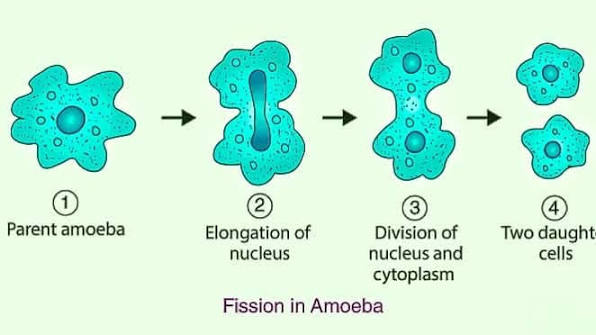
Binary fission is a type of asexual reproduction in which the parent organism divides into two equal – sized daughter cells.
Example: Amoeba and bacteria.
In Amoeba, the nucleus first divides into two, followed by division of the cytoplasm. Two daughter Amoebae are then formed.
2. BUDDING
Budding occurs when a small outgrowth or a bud-forms on the parent organism and finally detached to give rise to a new organism. The bud grows and eventually separates from the parent to live independently.
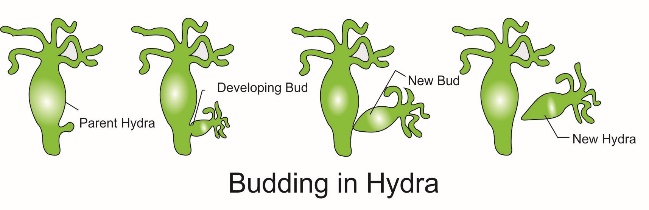
Examples: Yeast and Hydra.
3. FRAGMENTATION
Fragmentation occurs when the body of the parent organism divides into fragments and each fragment develop into a new organism.
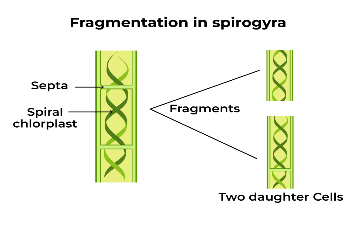
Example: Spirogyra.
4. SPORE FORMATION
In spore formation, the organism produces tiny reproductive structures called spores. When the spores reach a suitable environment, they germinate and develop into new organisms.
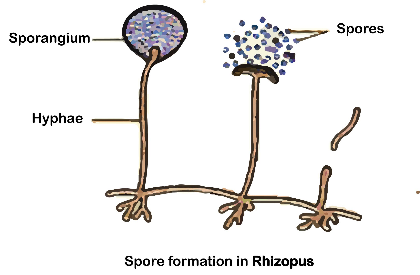
Example: Rhizopus (bread mould).
F. VEGETATIVE PROPAGATION
Vegetative propagation is a form of asexual reproduction in plants in which new plants develop from vegetative parts such as the stem, root or leaf instead of from seeds.
Examples: Stem (Cassava, sugarcane); Stem tuber (Potato); Bulb (Onion); Rhizome (Ginger) Leaf (Bryophyllum)
Vegetative propagation may be natural or artificial.
1. Natural Vegetative Propagation: Occurs naturally without human assistance. New plants grow from the stems, roots, or leaves of an existing parent plant without using seeds
2. Artificial Vegetative Propagation: Is carried out by humans using methods such as, Cutting, Grafting, Budding and Layering
G. ADVANTAGES OF ASEXUAL REPRODUCTION
i) Only one parent is needed.
ii) It is usually fast.
iii) Many offspring can be produced within a short period.
iv) It does not require finding a mate
v) Desirable characteristics of the parent are maintained.
vi) It is useful in agriculture for rapidly multiplying plants.
H. DISADVANTAGES OF ASEXUAL REPRODUCTIOND
i) There is little or no genetic variation among offspring.
ii) Diseases can spread easily among genetically similar organisms.
iii) The organisms may not adapt easily to environmental changes.
iv) Harmful characteristics of the parent may be passed directly to offspring.
I. DIFFERENCES BETWEEN SEXUAL AND ASEXUAL REPRODUCTION
Sexual Reproduction Asexual Reproductions
It involves two parents It involves one parent.
It involves male and female gametes Does not involve fusion of gametes.
Fertilization occurs. Fertilization does not occur.
Produces genetic variation Produces little genetic variation.
Usually, slower Usually faster.
J. SUMMARY
Reproduction is the process by which living organisms produce new individuals of their kind. It is essential for the continuation of life. The two major types are sexual and asexual reproduction.
Asexual reproduction involves only one parent and does not involve the fusion of gametes. Its major methods include binary fission, budding, fragmentation, spore formation and vegetative propagation. It Is generally fast but produces little genetic variation.
Evaluation
1. What is reproduction?
A. The process of obtaining food
B. The process by which organisms produce new individuals
C. The process of removing waste
D. The process of breathing
2. Which of the following is a major type of reproduction?
A. Binary reproduction
B. Asexual reproduction
C. Vegetative reproduction
D. Budding reproduction
3. Asexual reproduction involves
A. Two parents and fusion of gametes
B. Two parents without fertilisation
C. One parent without fusion of gametes
D. Many parents and many gametes
4. Which organism reproduces by binary fission?
A. Hydra
B. Amoeba
C. Yeast
D. Rhizopus
5. Budding is a method of asexual reproduction found in
A. Yeast and Hydra
B. Amoeba and Spirogyra
C. Potato and onion
D. Humans and goats
6. Which of the following is an example of reproduction by fragmentation?
A. Amoeba
B. Yeast
C. Spirogyra
D. Hydra
7. Which of the following is an example of vegetative propagation through a stem tuber?
A. Onion
B. Ginger
C. Potato
D. Bryophyllum
8. Which of the following is an advantage of asexual reproduction?
A. It always produces genetic variation
B. It requires two parents
C. It is usually rapid
D. It requires fertilisation
9. One major disadvantage of asexual reproduction is that it
A. requires two parents
B. produces little genetic variation
C. is always very slow
D. cannot produce many offspring
10. Which of the following correctly compares sexual and asexual reproduction?
A. Both involve fusion of gametes
B. Sexual reproduction involves one parent, while asexual reproduction involves two
C. Sexual reproduction produces variation, while asexual reproduction usually produces genetically similar offspring
D. Asexual reproduction is always slower than sexual reproduction
Theory Questions
THEORY QUESTIONS.
1a) Define reproduction.
1b) State FOUR importance of reproduction.
1c) Mention the two types of reproduction.
2a) What is asexual reproduction?
2b) State four characteristics of asexual reproduction.
2c) Explain binary fission and give one example.
2d) What is budding? Give two examples