
THE EARTH AS A PLANET Lesson Note
This SS1 Geography lesson note covers THE EARTH AS A PLANET for First Term, Week 3.
Learning Objectives
- At the end of the lesson, students should be able to:
- Describe the Earth as a planet.
- Explain the size and shape of the Earth.
- State and explain the proofs that the Earth is spherical.
- Differentiate between the Earth’s rotation and revolution.
- Explain the effects of the Earth’s rotation and revolution on man and the environment.
Lesson Note
A. THE EARTH
The Earth is one of the eight planets in the Solar System. It is the third planet from the Sun and the only known planet that supports life because it possesses water, oxygen, and a suitable atmosphere. The Earth is constantly in motion, rotating on its axis and revolving around the Sun.
B. THE SHAPE OF THE EARTH
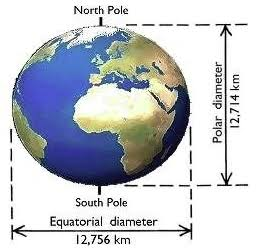
The earth is spherical in shape, it is not flat as some people think it is. It is slightly flattened at the poles to give a spherical shape. Thus, the earth’s shape is described as a geoid.
C. Characteristics of the Earth
1. It is approximately spherical in shape.
2. It is the only known planet that supports life.
3. About 71% of its surface is covered by water,and 29% is land.
4. It has an atmosphere containing oxygen, nitrogen, carbon dioxide, and other gases.
5. It rotates on its axis and revolves around the Sun.
D. THE SIZE OF THE EARTH
The Earth is very large and has the following dimensions:
i. Equatorial diameter: 12,756 km
ii. Polar diameter: 12,714 km
iii. Mean radius: 6,371 km
iv. Circumference at the equator: 40,075 km
v. Total surface area: About 510 million square kilometres
vi. The earth is the fifth largest planet in the solar system. The surface area of the earth is approximately 443 million square kilometres
E. PROOFS OF THE EARTH SPHERICITY:
Several scientific observations prove that the Earth is spherical:
1.The lunar eclipse: When there is a lunar eclipse, the Earth cast a circular shadow on the moon. In essence, only a sphere, like the earth can do such a thing.
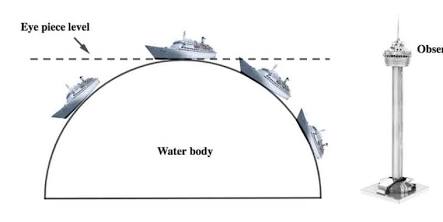
2.The visibility of a ship: When you view a ship moving towards a port. One will observe that the mask is first seen before the hull and later the rest of the ship body becomes visible over time.
Moreso, a ship does not disappear immediately it leaves a harbour rather it goes out sight gradually, and later disappears.
3. Photographic evidence: photographs taken from satellites and spacecraft from high altitude has clearly shown that the Earth has curved edges which can better be described as spherical.
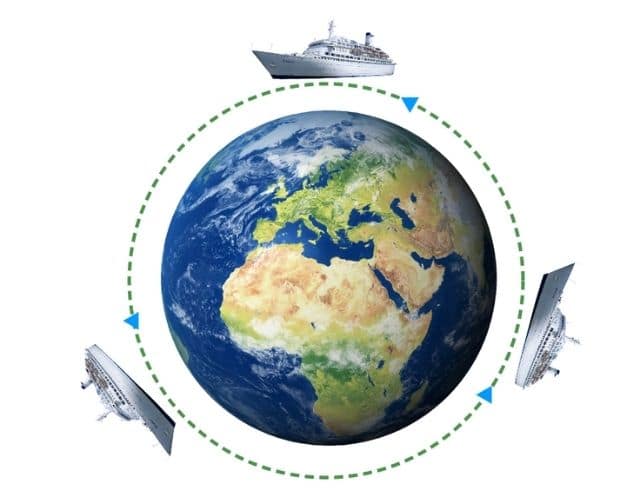
4.Circumnavigation of the Earth by ships and aircraft: Many scientists have been able to travel round the earth and they returned to the same point. The most spectacular of these journeys was the one carried out by Ferdinand Magellan and his crew from 1519 to 1522. During these they would have fallen off when they come across an abrupt edge.
5.Curved horizon: When a distance horizon is viewed from any Point on the earth, it gives a curved shape. And as one climbs higher, the curved horizon widens. Thus, it is only a spherical body that can manifest such attribute.
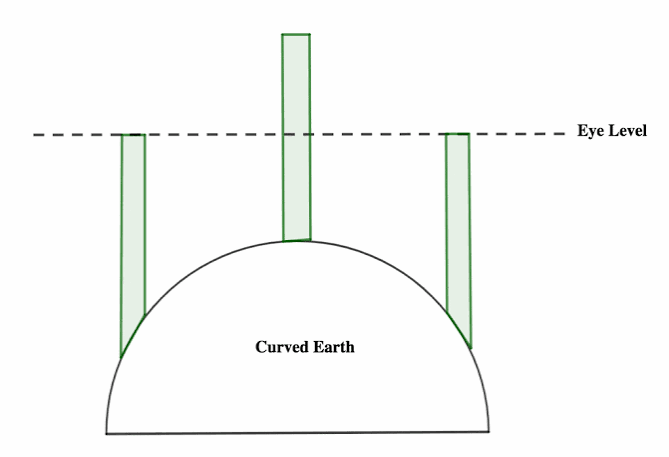
6.Driving pole of equal length on the Earth: If three poles are driven to the ground at the same depth, one will observe that the middle pole will be slightly taller than others due to the curvature of the earth. If the earth was flat, all the pole would have equal height.
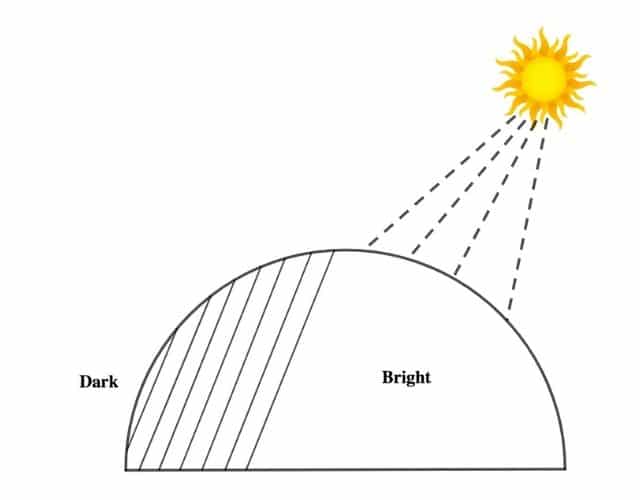
7. Sunrise and Sunset: Sunrise and sunset occur at different times in different places because the Earth is a sphere that rotates from west to east.
F. EARTH’S MOVEMENT
The movement of the earth is carried out in two ways:
1. Rotation
2. Revolution
1. ROTATION OF THE EARTH
The earth rotates or moves on its axis from west to east. These is done at an angle of 23 and a half along its axis. It takes the earth twenty-four hours which is equal to a day to complete one rotation. Thus, the earth rotates through 360 degrees in every 24hours
However, the Rotation of the earth causes day and night and that is why we have 24 hours in a day. That is 12 hour day light and 12 hours darkness.
Effects of Rotation
i. Causes Day and Night
ii. Creates differences in local time and time zones.
iii. Influences wind direction through the Coriolis effect.
iv. Affects ocean currents.
v. Regulates daily human activities and biological rhythms.
2. REVOLUTION OF THE EARTH
The earth moves or revolves around the sun on its orbit. As such, the revolving earth is tilted or inclined at an angle of elliptic during its Revolution.
Moreso, it takes the earth 365 and one quarter days to complete one revolution. Thus, the revolution of the earth causes four seasons in a year. The one year. The day or 6 hours is added up every year for four years to make a leap year. Therefore, a leap year has 366 days and it occurs every 4 years.
Effects of Revolution
i. Causes seasonal changes.
ii. Determines the length of one year.
iii. Influences climate an weather
iv. Affects agricultural activities such as planting and harvesting.
iv. Produces variations in the length of day and night during the year.
Evaluation
OBJECTIVE QUESTIONS
1. Which of the following best describes the shape of the Earth?
A. Flat
B. Oblate spheroid
C. Cube-shaped
D. Cylindrical
2. Which of the following is a proof that the Earth is spherical?
A. Rivers flow downhill.
B. Ships disappear gradually over the horizon.
C. Rain falls from clouds.
D. Mountains are high.
3. During a lunar eclipse, the Earth’s shadow on the Moon appears:
A. Square
B. Circular
C. Triangular
D. Rectangular
4. The movement of the Earth on its axis is known as:
A. Revolution
B. Rotation
C. Orbit
D. Rotational drift
5. How long does the Earth take to complete one rotation on its axis?
A. 12 hours
B. 24 hours
C. 30 days
D. 365 days
6. The movement of the Earth around the Sun is called:
A. Rotation
B. Revolution
C. Rotational movement
D. Orbital spinning
7. How long does the Earth take to complete one revolution around the Sun?
A. 24 hours
B. 30 days
C. 365¼ days
D. 100 days
8. Which of the following is an effect of the Earth’s rotation?
A. Change of seasons
B. Day and night
C. Leap year
D. Solar eclipse
9. Which of the following is an effect of the Earth’s revolution?
A. Day and night
B. Difference in local time
C. Change of seasons
D. Sunrise and sunset
10. Which of the following is NOT an effect of the Earth’s revolution?
A. Change of seasons
B. Leap year
C. Variation in the length of day and night
D. Day and night
Theory Questions
1a. Describe the shape and size of the earth.
1b. Identify and explain five proofs of the earth’s sphericity
2.Explain 5 impact of Rotation and revolution of man and his environment.