
THE SOLAR SYSTEM Lesson Note
This SS1 Geography lesson note covers THE SOLAR SYSTEM for First Term, Week 2.
Learning Objectives
- At the end of the lesson, students should be able to:
- Describe the solar system.
- State the components of the solar system and explain their characteristics.
- Analyse the benefits of the solar system to mankind.
Lesson Note
Learning Objectives
At the end of the lesson, students should be able to:
i) Describe the solar system.
ii) State the components of the solar system and explain their characteristics.
iii) Analyse the benefits of the solar system to mankind.
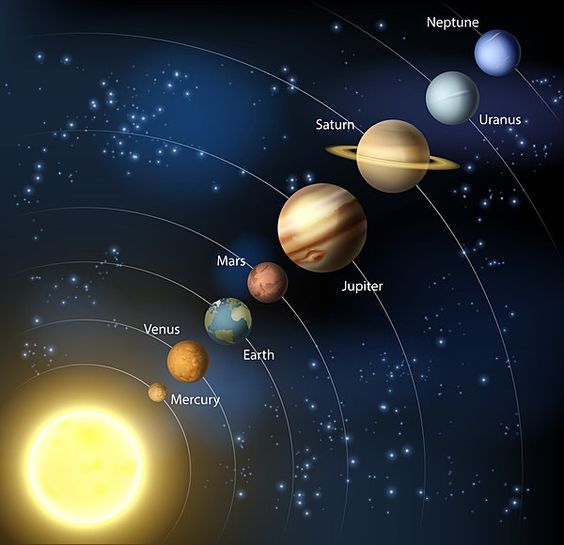
A. THE SOLAR SYSTEM
The solar system is the collection of celestial bodies that are gravitationally bound to the Sun. It consists of the Sun, eight planets, their natural satellites, dwarf planets, asteroids, comets, meteoroids, and other interplanetary materials. The Sun is the central body and contains about 99.8% of the total mass of the solar system.
The solar system is a planetary system with the Sun at its centre. All the planets and other celestial bodies revolve around the Sun in elliptical orbits due to the Sun's gravitational force. It formed approximately 4.6 billion years ago from a giant cloud of gas and dust known as the solar nebula.
B. COMPONENT OF THE SOLAR SYSTEM AND THEIR CHARACTERISTICS
1. The Sun
*The Sun is a medium-sized star located at the centre of the solar system. It is the primary source of light and heat.
*The sun is mainly composed of hydrogen and helium.
*It generates energy through nuclear fusion
2. The Eight Planets
The planets in order from the Sun are: Mercury, Venus, Earth, Mars, Jupiter, Saturn, Uranus and Neptune.
i) Mercury: This is the smallest, hottest and closest planet to the Sun. No living thing can be found here because the planet has the highest surface temperature. It takes eighty-eight (88) days to complete its orbit. It’s distance from the Sun is about 57,900,000km. That is 36,000 miles. Mercury has no satellite of its own.
ii) Venus: This is the second closest planet to the sun. No living organism can also survive here because of its high temperature. Interestingly, it is often referred to as “the earth twin” due to their proximity in size, mass and density. It takes Venus 225 Earth days to complete its revolution. The distance of Venus from the Sun is about 107,200,000km and it has no satellite of its own.
iii) Earth: The earth is the only planet which support the existence of plants and animals. The moon is it’s only natural satellites and it revolves eastward around the earth once in every twenty-seven (27) days. It takes the earth 365days and 6 hours to complete its orbit. The distance of the earth from the sun is approximately 148,800,000km, which is about (93,000,000) mile.
iv) Mars: Mars has a possibility of supporting some plants life, but human beings can not survive there due to little or no oxygen to enhance respiration. The planet has two satellites and it distance from the sun is approximately 227,200,000km.687 days is required for Mars to complete it’s orbit.
v. Jupiter: This is the largest planet in the solar system. Its surface contains gases such as hydrogen and methane with light and dark bands.
It has twelve (12) satellites and it’s distance from the Sun is approximately 772,800,000km Jupiter travels for about 12 years to complete it’s orbit.
vi) Saturn: Saturn is the largest planet in the solar system after Jupiter. It has three rings and nine satellites. The distance of Mercury from the Sun is approximately 1,417,600,000km and it takes about thirty (30) years to complete its orbit.
vii) Uranus: Uranus is the only planet that orbit around the earth in a clockwise direction from east to West. Other planet orbit around the earth in an anticlockwise direction from west to east. It has five(5) satellites. Uranus spend about 84 years to complete its orbit and it’s distance from the Sun is approximately 2,854,400,000km.
viii) Neptune: Neptune is the farthest planet from the Sun. Thus, It is very coldest planet in the solar system due to its low temperature .It has two satellites and requires about 84 day for it to orbit around the sun.The distance of Neptune from the sun is approximately 4,468,800,000km.
C. GENERAL CHARACTERISTICS OF THE PLANNETS
a. They revolve around the Sun in elliptical orbits.
b. They rotate on their own axes.
c. They do not produce their own light but reflect sunlight. They differ in size, composition, and distance from the Sun.
d. The inner planets are rocky (terrestrial), while the outer planets are gaseous (Jovian).
D. Natural Satellites (Moons)
*These are bodies that orbit planets.
*They reflect sunlight.
*Earth's natural satellite is the Moon.
E. Dwarf Planets
*Smaller than the major planets.
*Orbit the Sun but have not cleared their orbital paths.
*Examples include Pluto, Eris, and Ceres.
F. Asteroids
*Small rocky bodies orbiting the Sun.
*Most are located in the asteroid belt between Mars and Jupiter.
G. Comets
*Composed mainly of ice, dust, and gases.
*They develop bright tails when they approach the Sun.
H. Meteoroids, Meteors, and Meteorites
*Meteoroids: Small rocky or metallic objects in space.
*Meteors: Meteoroids that burn up while entering Earth's atmosphere.
*Meteorites: Fragments that survive and reach the Earth's surface.
I. Interplanetary Dust and Gas
*Tiny particles distributed throughout the solar system.
*They contribute to the formation of celestial bodies.
J. BENEFIT OF THE SOLAR SYSTEM TO MAN
1. The Sun provides light and heat necessary for life.
2. Solar energy is used to generate electricity and dry agricultural products.
3. The Earth's movement around the Sun causes seasons, influencing agriculture.
3. The solar system provides a basis for measuring time through days, months, and years.
4. Space exploration has led to scientific discoveries and technological advancements.
5. Satellite technology supports communication, navigation, weather forecasting, and environmental monitoring.
6. Knowledge of the solar system improves understanding of Earth's position and environmental processes.
7. Astronomy contributes to education, research, and national development.
Evaluation
OBJECTIVE QUESTIONS
1.What is the best description of the solar system?
A. A group of stars and galaxies
B. The Sun and all the objects that revolve around it
C. A collection of only planets
D. A group of moons
2.Which of the following is at the center of the solar system?
A. Earth
B. Moon
C. Sun
D. Mars
3.Which of the following is not a component of the solar system?
A. Planets
B. Asteroids
C. Rivers
D. Comets
4.Which planet is known as the largest planet in the solar system?
A. Earth
B. Jupiter
C. Mars
D. Venus
5.Which of the following is a natural satellite in the solar system?
A. Moon
B. Sun
C. Mercury
D. Venus
6.Which component of the solar system provides light and heat to the Earth?
A. Moon
B. Jupiter
C. Sun
D. Saturn
7.One benefit of the solar system is that it:
A. Provides sunlight that supports life on Earth
B. Stops the Earth from rotating
C. Makes the oceans disappear
D. Prevents rainfall
8.Why is the Sun important to the solar system?
A. It is the smallest object
B. It gives energy and keeps planets in orbit through gravity
C. It is a natural satellite
D. It revolves around the Earth
9.Which of the following is a benefit of studying the solar system?
A. It helps us understand space and our planet better
B. It prevents earthquakes
C. It changes the weather every day
D. It creates new planets
10.Which of the following is a component of the solar system?
A. Galaxy
B. Comet
C. Continent
D. Ocean
Theory Questions
EVALUATION(Theory)
1a. Describe the solar system.
1b. Mention the planets with natural satellites
2a. List and explain any five components of the solar system.
2b. State and explain five benefits of the solar system.