
KARST (LIMESTONE) REGION Lesson Note
Learning Objectives
This SS3 Geography lesson note covers KARST (LIMESTONE) REGION for First Term, Week 2.
Lesson Note
Learning Objectives
At the end of the lesson, students should be able to:
I Define karst (limestone) topography.
Ii Identify karst regions in Nigeria and other parts of the world.
Iii State the characteristics of karst topography.
Iv Describe the surface and underground features of a karst region.
V. Explain the importance of karst regions.
MEANING OF KARST (LIMESTONE) TOPOGRAPHY
Karst topography is a type of landscape formed by the solution of soluble rocks, especially limestone, by slightly acidic rainwater and groundwater. It is characterized by distinctive surface and underground landforms such as caves, sinkholes, and limestone pavements.
KARST REGIONS IN NIGERIA
Examples include:
1.Arochukwu area (Abia State)
2.Nkalagu (Ebonyi State)
3.Ewekoro (Ogun State)
4.Ashaka (Gombe State)
5.Obajana (Kogi State)
KARST REGION OF THE WORLD
1.The Dinaric Karst (Slovenia, Croatia, Bosnia and Herzegovina)
2.Guilin (China)
3.Mammoth Cave Region (Kentucky, USA)
4.Yucatán Peninsula (Mexico)
5.Peak District (United Kingdom)
CHARACTERISTICS OF KARST TOPOGRAPHY
1. Formed mainly on limestone rocks.
2. Limestone is highly permeable due to cracks and joinjoin
3. surface drainage is poorly developed because water sinks underground.
4. Underground drainage system is well developed.
5. The landscape contains caves, sinkholes, and disappearing streams.
6. Chemical weathering (solution) is the major process of formation.
7. The land is often rocky and rugged.
SURFACE FEATURES OF KARST REGION
1. Limestone Pavement: A flat, exposed limestone surface divided by cracks.
2. Clints and Grikes: Clints are limestone blocks, while grikes are deep cracks between them.
3. Sinkholes (Dolines): Circular depressions formed by the collapse or dissolution of limestone.
4. Swallow Holes: Openings where streams disappear underground.
5. Dry Valleys: Valleys without permanent rivers due to underground drainage.
6. Uvalas: Large depressions formed by the merging of several sinkholes.
7. Poljes: Very large, flat-floored depressions surrounded by steep limestone hills.
UNDERGROUND FEATURES OF KARST REGION
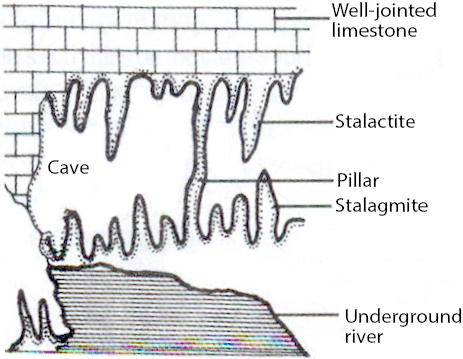
1. Caves or Caverns: Large underground chambers formed by the dissolution of limestone.
2. Underground Streams and Rivers: Water flows beneath the surface through caves.
3. Stalactites: Icicle-shaped deposits hanging from cave roofs.
4. Stalagmites: Cone-shaped deposits rising from cave floors.
5. Pillars (Columns): Formed when stalactites and stalagmites join together.
IMPORTANCE OF KARST REGION
1. Limestone is used in the manufacture of cement.
2. It provides raw materials for making lime and other industrial products.
3. Caves serve as tourist attractions, generating revenue.
4. Underground water supplies are important sources of freshwater.
5.Karst landscapes provide habitats for unique plants and animals.
6. Scientific research is carried out in caves and limestone formations.
7. Some caves have historical, cultural, and archaeological significance.
Evaluation
OBJECTIVE QUESTIONS
1. Karst topography is mainly developed on rocks made of
A. Granite
B. Basalt
C. Limestone
D. Sandstone
2. The major process responsible for the formation of karst topography is A. Oxidation
B. Solution
C. Erosion by wind
D. Volcanic activity
3. A depression formed by the collapse or dissolution of limestone is called a
A. Plateau
B. Sinkhole
C. Delta
D. Gorge
4.The opening through which a surface stream disappears underground is known as a
A. Waterfall
B. Swallow hole
C. Meander
D. Floodplain
5. Which of the following is an underground feature of a karst region?
A. Inselberg
B. Mesa
C. Cave
D. Escarpment
6. Stalactites are formed by the deposition of calcium carbonate on the
A. Cave floor
B. Cave roof
C. River bed
D. Valley side
7. Which of the following is a characteristic of a karst region?
A. Well-developed surface drainage B. Thick volcanic lava
C. Underground drainage system
D. Extensive sand dunes
8.Which of the following is a karst region in Nigeria?
A. Nkalagu
B. Jos Plateau
C. Mambilla Plateau
D. Niger Delta
9.Limestone is an important raw material used mainly in the production of
A. Paper
B. Cement
C. Glass
D. Plastic
10.Which of the following features is formed when a stalactite joins with a stalagmite?
A. Cliff
B. Arch
C. Pillar (Column)
D. Ridge
(THEORY)
1a. Define karst(lime stone) topography
1b. Identify some lime stone region in nigeria and other part of the world
2a. Mention 5 characteristics of lime stone topography
2b. Explain 5 importance of limestone regions