
VULCANICITY Lesson Note
This SS3 Geography lesson note covers VULCANICITY for First Term, Week 1.
Learning Objectives
- At the end of the lesson, students should be able to:
- i. Explain the meaning and process of vulcanicity
- ii. identify regions of Vulcanic occurrence
- iii. Describe the characteristics and form of intrusive and extrusive features of volcanicity
- iv. Analyse the effect of volcanicity on man and his environment.
Lesson Note
A. MEANING AND PROCESSES OF VULCANICITY
Meaning of Volcanicity
Volcanicity (or vulcanicity) is the process by which molten rock (magma), gases, and other materials move from the Earth's interior to the surface or become trapped beneath the Earth's crust. These activities lead to the formation of volcanic landforms.
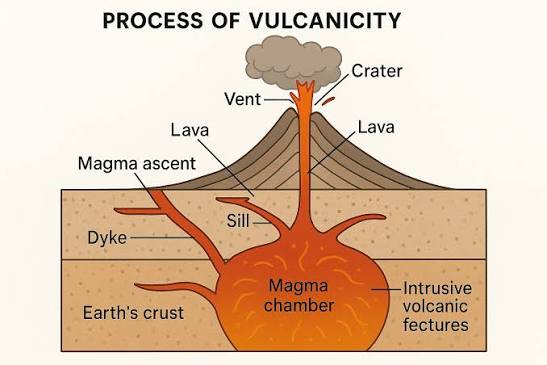
PROCESS OF VOLCANICITY
The process of volcanicity involves the following steps:
i) Heat inside the Earth melts rocks to form magma.
ii) The magma accumulates in a magma chamber beneath the Earth's crust.
iii) Pressure builds up due to gases dissolved in the magma.
iv) The magma rises through cracks and weak zones in the crust.
v) If the magma reaches the Earth's surface, it erupts as lava, ash, and gases, forming extrusive features.
vi) If the magma cools before reaching the surface, it solidifies underground to form intrusive features.
B. REGIONS OF VULCANIC OCCURRENCE
Volcanic activities are common in the following regions:
1. The Pacific Ring of Fire (around the Pacific Ocean).
2. Mid-Atlantic Ridge.
3. East African Rift Valley.
4. Mediterranean volcanic belt.
5. Iceland.
6. Indonesia.
7. Japan.
8. Philippines.
9. Hawaii.
10. Andes Mountains of South America.
C. CHARACTERISTICS AND FORMS OF INTRUSIVE AND EXTRUSIVE FEATURES
1. Intrusive landforms
These are landforms formed when magma cools and solidifies beneath the Earth's surface.
CHARACTERISTICS
i) Form underground.
ii) Cool slowly.
iii) Have coarse-grained crystals.
iv) Become exposed after erosion removes the overlying rocks.
FORMS OF INTRUSIVE LANDFORM
i. Batholith – Very large mass of solidified magma beneath the surface.
ii. Laccolith – Dome-shaped intrusion that pushes overlying rocks upward.
iii. Sill – Horizontal sheet of magma between rock layers.
iv. Dyke (Dike) – Vertical or steep sheet of magma cutting across rock layers.
v. Volcanic Plug – Hardened magma filling the volcanic vent.
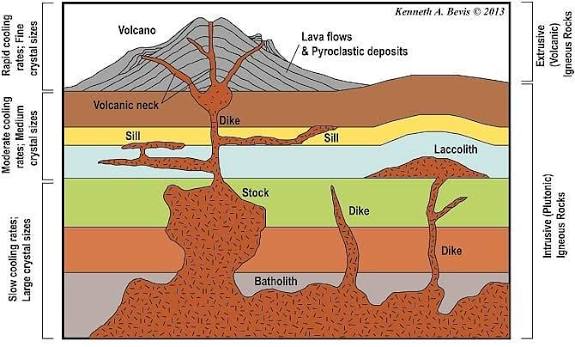
2. EXTRUSIVE LAND FORM
These are formed when lava reaches the Earth's surface and cools.
CHARACTERISTICS
i) Form on the Earth's surface.
ii) Cool rapidly.
iii) Have fine-grained crystals.
iv) Often produce volcanic cones and lava flows.
FORMS OF EXTRUSIVE LANDFORM
i. Volcanic Cone – Cone-shaped mountain formed from lava and ash.
ii. Shield Volcano – Broad volcano with gentle slopes formed by fluid lava.
iii. Composite Volcano (Stratovolcano) – Steep-sided volcano made of alternating layers of lava and ash.
iv. Lava Plateau – Flat elevated land formed by repeated lava flows.
v. Crater – Bowl-shaped opening at the summit of a volcano.
vi. Caldera – Large depression formed when the top of a volcano collapses after an eruption.
D. EFFECT OF VULCANICITY ON MAN
Positive Effects:
i. Produces fertile soils suitable for agriculture.
ii. Provides valuable minerals such as copper, gold, and sulphur.
iii. Generates geothermal energy for electricity.
iv. Attracts tourists, creating jobs and income.
v. Forms new land and islands.
Negative Effects:
i. Loss of lives during volcanic eruptions.
ii. Destruction of houses, roads, and farmlands.
iii. Air pollution from volcanic ash and gases.
iv. Health problems such as breathing difficulties.
v. Damage to vegetation and wildlife.
vi. Disruption of transportation and communication.
Evaluation
OBJECTIVES
1.Which of the following best describes vulcanicity?
A. The wearing a way of rocks by wind
B. The process involving the movement of molten rock to or onto the Earth’s surface
C. The formation of sedimentary rocks
D. The movement of glaciers
2.Which of the following is an intrusive volcanic feature?
A. Lava plateau
B. Volcanic cone
C. Sill
D. Ash cone
3. Magma that reaches the Earth’s surface is called:
A. Basalt
B. Lava
C. Ash
D. Granite
4. Which of the following is an example of an extrusive volcanic landform?
A. Dyke
B. Batholith
C. Laccolith
D. Lava plateau
5. The opening through which magma erupts onto the Earth’s surface is known as:
A. Crater
B. Vent
C. Caldera
D. Cone
6. Which of the following materials is commonly ejected during a volcanic eruption?
A. Limestone
B. Sandstone
C. Volcanic ash
D. Coal
7. A large circular depression formed after the collapse of a volcano is called:
A. Plateau
B. Gorge
C. Caldera
D. Ridge
8. Which of the following is NOT an intrusive volcanic feature?
A. Dyke
B. Sill
C. Batholith
D. Volcanic cone
9.Which of the following is a major benefit of vulcanicity?
A. Desertification
B. Fertile soils for agriculture
C. Soil erosion
D. Flooding
10.Which of the following is a harmful effect of volcanic eruptions?
A. Formation of fertile plains
B. Creation of tourist attractions
C. Loss of lives and destruction of property
D. Formation of mineral deposits
Theory Questions
1a) Explain the meaning and process of vulcanicity.
b) Identify five (5) regions of volcanic occurrence
2a) differentiate between intrusive and extrusive landform
b) Analyse the effect of vulcanicity on man and his environment