
Week 4 Lesson Note
TOPICS: DEMAND AND SUPPLY
This SS2 Economics lesson note covers Week 4 for First Term, Week 4.
Lesson Note
TOPICS: DEMAND AND SUPPLY
Learning Objectives
Define demand and supply.
Distinguish between change in quantity demanded and change in demand.
Distinguish between change in quantity supplied and change in supply.
Explain the causes of changes in demand and supply.
Explain equilibrium price and equilibrium quantity.
Describe the effects of changes in demand and supply on equilibrium price and quantity.
Apply the concepts to simple market situations.
A. MEANING OF DEMAND
Demand may be defined as the ability and willingness to buy a specific quantity of goods or services at a given price and at a particular period of time
B. EFFECTIVE DEMAND: is defined as a desire backed up by ability and willingness to pay for specific quantities of a commodity at alternative prices and within a period of time
C. MEANING OF SUPPLY
Supply is the quantity of a commodity that producers is willing and able to offer for sale at a particular price and at a particular period of time
D. EFFECTIVE SUPPLY refers to the part of the total production actually offered for sale at the ruling market price and at. A particular time
E. CHANGE IN QUANTITY DEMANDED
A change in quantity demanded of a commodity means a movement from one point to another on a demand curve the cause of the change in the quantity demanded is due to changes in the price of the commodity under consideration the quantity of a commodity of a commodity demanded changes with price
A change in quantity demanded is of two parts
1. An increase in quantity demanded
there is an increase in the quantity demanded provided the quantity provided the quantity purchased increases as a result of a decrease in the price of the commodity
Diagram illustrating an increase in quantity demanded
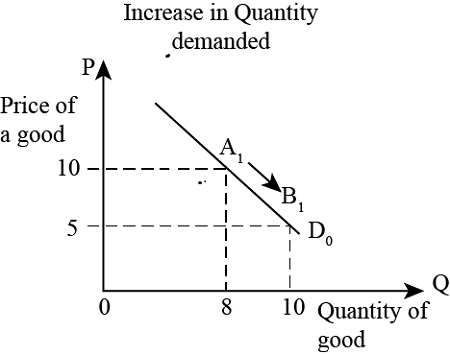
In the diagram above, a decrease in the price of the commodity from N10 to N5 bought about an increase in the quantity purchased from 8 units to 10 units
2. A decrease in quantity demanded occurs when price rises there is a decrease in the quantity demanded if the quantity of the commodity purchased decreases as a result of an increase in price
A diagram illustrating a decrease in the quantity demanded
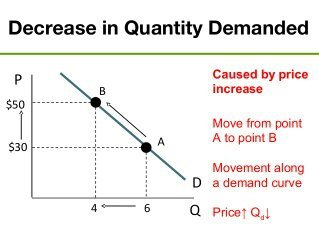
This is also called an extension or contraction of demand.
F. SHIFT OR CHANGE IN DEMAND
There is a change in demand if the demand curve shift to an entire new position in this case there is a completely new demand schedule and demand curve showing that at the old price more or less of the commodity would be purchased a shift or change in demand is determined by other factors affecting demand except the price of the commodity
A shift or change in demand is also grouped in two division
1. Increase in demand: when there is an increase in demand the demand curve shift to the right indicating that at the old price more of the commodity will be purchased for example of the income of consumer increases more of the commodity is likely to be purchased at the old price
diagram illustrating shift or change in demand (increase in demand)
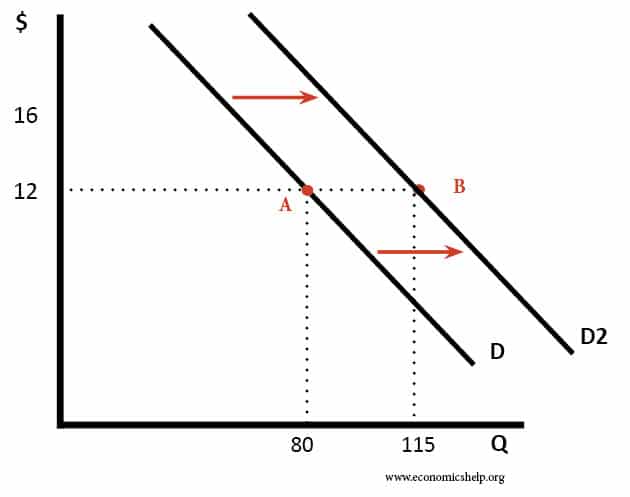
In the diagram above the demand curve move from D to D2 with the same price of $12 and the quantity demanded also increase from 80 units to 115 units.
2. Decrease in demand: when there is a decrease in demand the demand curve will shift to the left indicating that at the old price less of the commodity is being purchased a decrease in demand is brought about by an unfavourable change in any of the factors affecting demand except the price of the commodity
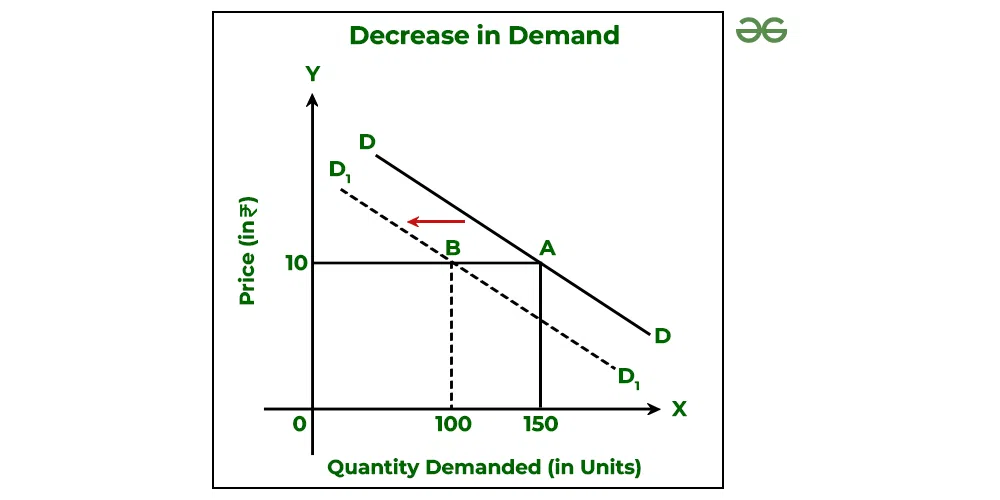
G. FACTORS THAT CAN CAUSE A CHANGE IN DEMAND
These include:
1. Income of consumers
2. Prices of related goods (substitutes and complements)
3. Taste and fashion
4. Population or number of consumers
H. CHANGE IN QUANTITY SUPPLIED
A change in quantity supplied of a commodity means a movement from one point to another on a supply curve the cause of the change in the quantity supplied is as a result of the change in the price of the commodity under consideration the quantity of a commodity supplied changes with price more is supplied at a higher price than at a lower price
A change in the quantity supplied is of two types
1. Increase in the quantity supplied: there is an increase in the quantity supplied if the quantity supplied increases as a result of an increase in the price of the commodity
2. A decrease in the quantity supplied: there is a decrease in the quantity supplied if the quantity of the commodity supplied decreases as a result of a decrease in price
I. SHIFT OR CHANGE IN SUPPLY
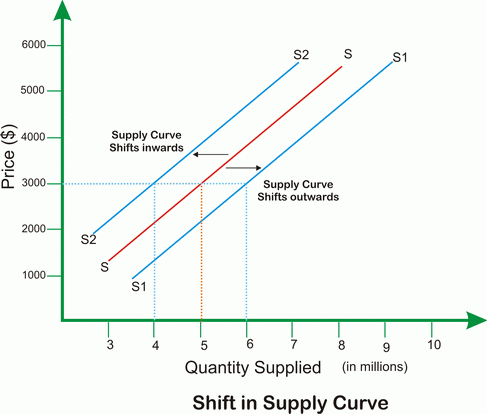
There is a change in supply if the supply curve shift to an entirely new position there is a completely new supply schedule and supply curve
A shift or change in supply is also grouped in to two division
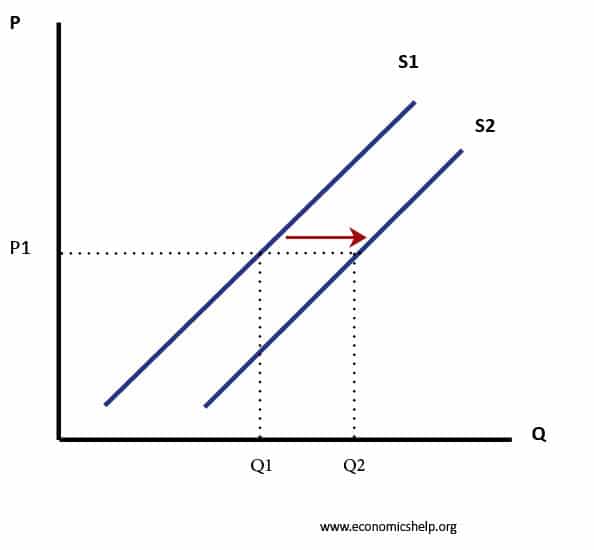
1. Increase in supply: when there is an increase in supply the supply curve will shift to the right indicating that at the old price more of the commodity will be supplied an increase in supply is brought about by a favourable change in the factors affecting supply other than the price of the commodity
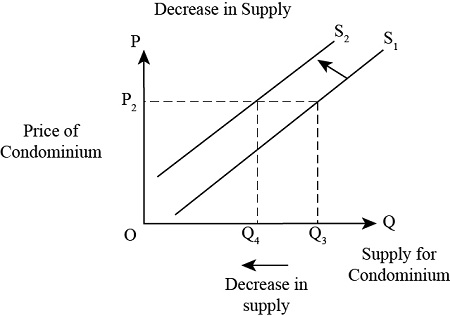
2. Decrease in supply: when there is a decrease in supply the supply curve will shift to the left indicating that at the old price less of the commodity is being supplied a decrease in supply is brought about by an unfavourable change in any of the factors affecting supply except the price of the commodity
J. FACTORS THAT CAN CAUSE A CHANGE IN SUPPLY
These include:
Cost of factors of production
Technology
Taxes and subsidies
Prices of other goods that producers can make
K. EQUILIBRIUM PRICE AND QUANTITY
Equilibrium occurs where quantity demanded equals quantity supplied. The price at which this happens is called the equilibrium price, and the quantity bought and sold at that price is the equilibrium quantity.
At equilibrium:
1. Quantity demanded = Quantity supplied.
2. There is neither a shortage nor a surplus.
L. EFFECTS OF CHANGES IN DEMAND ON EQUILIBRIUM
1. Increase in demand with supply unchanged: equilibrium price rises and equilibrium quantity rises.
2. Decrease in demand with supply unchanged: equilibrium price falls and equilibrium quantity falls.
M. EFFECTS OF CHANGES IN SUPPLY ON EQUILIBRIUM
1. Increase in supply with demand unchanged: equilibrium price falls and equilibrium quantity rise.
2. Decrease in supply with demand unchanged: equilibrium price rises and equilibrium quantity falls.
Evaluation
OBJECTIVES QUESTIONS
1. Demand refers to the quantity of a commodity consumers are willing and able to buy at various prices during a given period. Which condition is essential for effective demand?
A. Willingness only
B. Ability only
C. Willingness and ability to pay
D. Government approval
2. A movement along the same demand curve caused by a change in the commodity's own price is called:
A. Change in demand
B. Change in quantity demanded
C. Change in supply
D. Increase in supply
3. Which of the following can cause a change in demand?
A. Change in the price of the commodity itself
B. Change in consumer income
C. Movement along the supply curve
D. Quantity supplied
4. An increase in demand, with supply unchanged, will normally cause equilibrium price to:
A. Fall
B. Remain unchanged
C. Rise
D. Become zero
5. A change in quantity supplied is caused by a change in the:
A. Producer's taste
B. Price of the commodity itself
C. Number of consumers
D. Consumer incomer
6. Which of the following causes a shift of the supply curve?
A. Change in the commodity's own price
B. Change in production technology
C. Movement along the demand curve
D. Change in quantity demanded
7. If supply increases while demand remains unchanged, equilibrium price will generally:
A. Rise
B. Fall
C. Remain unchanged
D. Double
8. Equilibrium price is the price at which:
A. Demand is greater than supply
B. Supply is greater than demand
C. Quantity demanded equals quantity supplied
D. Producers make losses
9. If demand decreases and supply remains unchanged, equilibrium quantity will normally:
A. Rise
B. Fall
C. Remain unchanged
D. Become unlimited
10. Which statement is correct when supply decreases and demand remains unchanged?
A. Price falls and quantity rises
B. Price rises and quantity falls
C. Price and quantity both rise
D. Price and quantity both fall
Theory Questions
1a. Define demand and supply.
Ib. State four factors that can cause a change in demand.
1c. What is a change in quantity supplied?
2a. What is equilibrium price?
2b. What happens to equilibrium price and quantity when demand increases and supply remains unchanged?