
FAMILIES OF ELEMENTS (PERIODIC TABLE GROUP Lesson Note
This SS2 Chemistry lesson note covers FAMILIES OF ELEMENTS (PERIODIC TABLE GROUP for First Term, Week 2.
Learning Objectives
- By end of lesson, students should be able to:
- Define families of elements
- State why elements in same group have similar properties
- List 5 major families with examples
- Describe properties of each family
Lesson Note
MEANING
WHAT ARE FAMILIES OF ELEMENTS?
The Periodic Table arranges elements in order of increasing atomic number. Vertical columns are called GROUPS or FAMILIES.
Definition: A family of elements is a group of elements in the same vertical column of the periodic table that have the same number of valence electrons and similar chemical properties.
Elements in same family have same number of outer shell electrons → they react similarly.
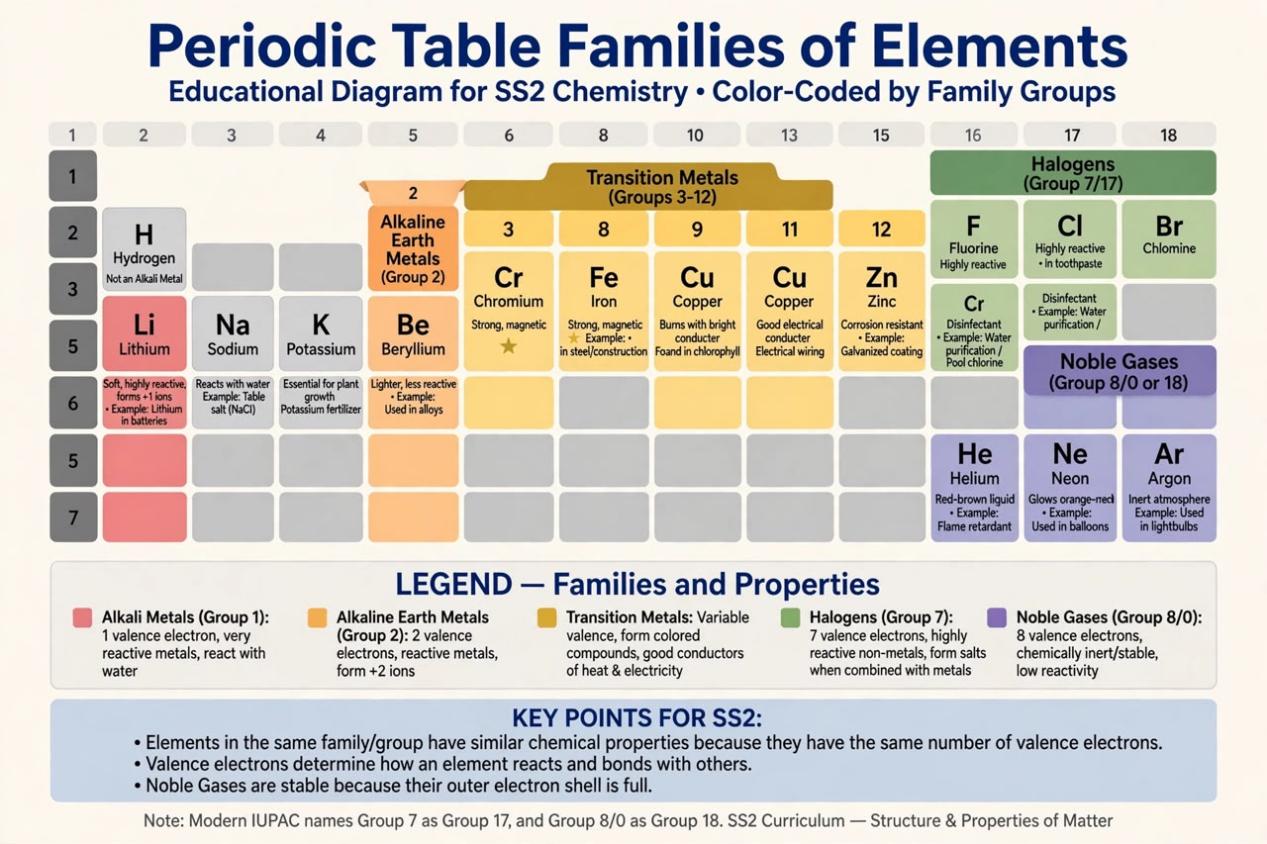
MAJOR FAMILIES OF ELEMENTS
A. ALKALI METALS - GROUP 1 (I)
Members: Lithium (Li), Sodium (Na), Potassium (K), Rubidium (Rb), Caesium (Cs), Francium (Fr)
Properties:
i) Have 1 valence electron, valency 1+
ii) Very reactive metals, reactivity increases down the group (K > Na > Li)
iii) Soft metals, can be cut with knife, low density
iv) React with water to produce hydrogen + alkali: 2Na + 2H2O →2NaOH + H2
v) React with oxygen to form oxides, with chlorine to form white salts e.g. NaCl
vi) Good reducing agents
Uses: Sodium in table salt (NaCl), sodium lamps, potassium fertilizer
B. ALKALINE EARTH METALS - GROUP 2 (II)
Members: Beryllium (Be), Magnesium (Mg), Calcium (Ca), Strontium (Sr), Barium (Ba)
Properties:
i) Have 2 valence electrons, valency 2+
ii) They are less reactive than Group 1
iii) React with water to form an alkaline solution except (Ba)
iv) Form white compounds, their oxides are basic
v) Flame colours: Ca - brick red, Ba - apple green
Vi) Strong reducing agent
Uses: Mg in alloy, Ca in cement, bones and teeth as $Ca_3(PO_4)_2$
C. TRANSITION METALS - GROUPS 3-12 (Middle of table)
Members: Iron (Fe), Copper (Cu), Zinc (Zn), Chromium (Cr), Manganese (Mn), Nickel (Ni)
Properties:
i) Variable valency e.g. Fe2+, Fe3+, Cu+, Cu2+
ii) Hard, strong metals with high melting points
iii) Good conductors of heat and electricity
iv) Form coloured compounds e.g. CuSO4 is blue
v) Form complex ions
vi) Used as catalysts
D. HALOGENS - GROUP 7
Members: Fluorine (F), Chlorine (Cl), Bromine (Br), Iodine (I), Astatine (At)
Properties:
i) Have 7 valence electrons, valency 1-
ii) Most reactive non-metals, reactivity decreases down the group (F is most reactive)
iii) Exist as diatomic molecules F2, Cl2, Br2, I2
iv) Physical states: F= gas, Cl= gas, Br= liquid, I= solid at room temp
v) Form salts with metals
vi) Good oxidizing agents, they bleach
Uses: Chlorine for water purification, fluorine in toothpaste, iodine as antiseptic, bromine in photography
E. NOBLE GASES / RARE GASES - GROUP 8/0
Members: Helium (He), Neon (Ne), Argon (Ar), Krypton (Kr), Xenon (Xe)
Properties:
i) Have 8 valence electrons (He has 2) - outer shell is full (octet) - STABLE
ii) Chemically inert / unreactive - do not form compounds easily
iii) Exist as monoatomic gases
iv) Low boiling points
v) Used to provide inert atmosphere
Uses: Argon in light bulbs, helium in balloons and aircraft, neon in advertisement lights
GENERAL TRENDS IN A FAMILY
As you go DOWN a group:
1. Atomic number increases
2. Number of shells increases
3. Atomic radius increases
4. Reactivity increases for metals (Group 1 & 2), but decreases for non-metals (Group 7)
5. Ionization energy decreases
Evaluation
OBJECTIVE QUESTIONS (10 Questions)
1. Vertical columns in the periodic table are called:
A) Periods
B) Groups/Families
C) Blocks
D) Series
2. Elements in the same family have similar chemical properties because they have:
A) Same atomic number
B) Same number of shells
C) Same number of valence electrons
D) Same mass number
3. Which group is known as Alkali metals?
A) Group
2 B) Group 1
C) Group 7
D) Group 0
4. The most reactive element in Group 1 is:
A) Lithium
B) Sodium
C) Potassium
D) Francium
5. Which element reacts violently with cold water to produce hydrogen gas?
A) Calcium
B) Sodium
C) Magnesium
D) Argon
6. Halogens have a valency of:
A) 1+
B) 2+
C) 1-
D) 2-
7. Which of the following exists as a liquid at room temperature?
A) Fluorine
B) Chlorine
C) Bromine
D) Iodine
8. Noble gases are unreactive because:
A) They have 7 valence electrons
B) Their outer shell is completely filled with electrons (octet)
C) They are metals
D) They have high density
9. Which of these is a property of transition metals?
A) Low melting point
B) Form only white compounds
C) Have variable oxidation states and form coloured compounds
D) Very soft
10. As you go DOWN Group 1, the reactivity:
A) Decreases
B) Increases
C) Remains same
D) Becomes zero
Theory Questions
QUESTION 1
a) Define families of elements and state why elements in same group show similar chemical behaviour.
b) List the members of the following families: i) Alkali metals ii) Halogens iii) Noble gases
c) State 2 properties and 1 use of each: Alkali metals and Halogen
QUESTION 2:
a) Differentiate between Alkaline earth metals and Transition metals under: i) Position in periodic table ii) Valency iii) Nature of compounds formed.
b) The electronic configuration of an element is 2,8,8,2. Identify the element, its group, family, and write equation of its reaction with cold water.