
PERIOD TABLE Lesson Note
DEFINITION:
This SS2 Chemistry lesson note covers PERIOD TABLE for First Term, Week 1.
Learning Objectives
- Brief History of period table
- Differentiate between the group and period of periodic table
- Lists elements into s, p, d and f blocks
Lesson Note
DEFINITION:
Periodic table is the arrangement of elements into group and period based on their atomic numbers.
PEIODIC LAW:
The modern periodic law states that the properties (physical and chemical) of elements are the periodic functions of their atomic numbers.
HISTROY OF PERIODIC TABLE:
The periodic table evolved over a period of time through the key work of Antoine Lavoisier, Dmitri Mendeleev and Henry Moseley.
In 1789, Antoine Lavoisier grouped 33 elements into gases, non-metals, metals and earths.
In 1869, a Russian scientist Dmitri Mendeleev created the framework for periodic table by ordering elements by atomic weight and grouping them according to common properties. He also created gaps for yet to be discovered elements.
But in 1913, Henry Moseley discovered atomic numbers (proton count), reorganizing the table by atomic number rather than mass.
GROUPS IN PERIODIC TABLE:
These are vertical columns of elements on the periodic table numbered from 0 to 7. Elements in the same group contain the same number of valence electrons. That is the number of electrons in their outer shells are the same e.g. group elements include:
Hydrogen (1) Electron (1) Outer shell (1)
Lithium (3) Electrons (2,1) Outer shell (1) Group 1 elements
Sodium (11) Electrons (2,8,1) Outer shell (1)
Hydrogen though shared some attributes of group seven elements; it is placed in group one due to its outer shell contain one electron.
Helium with two electrons and other elements having eight valence electrons are placed in group 0.
The transition groups of elements lie between Groups 2 and 3 in the periodic table.
PERIODS
These are horizontal rows of elements on the periodic table numbered from 1 to 7. Elements in the same period have the same number of shells. The number of valence electrons of the elements in the same period increases progressively by one across the period from left and right.
Among the elements in periods 6 and 7 are the elements of the lanthanide and actinide series. These are also referred to as the inner transition elements.
FEATURES OF PERIODIC TABLE
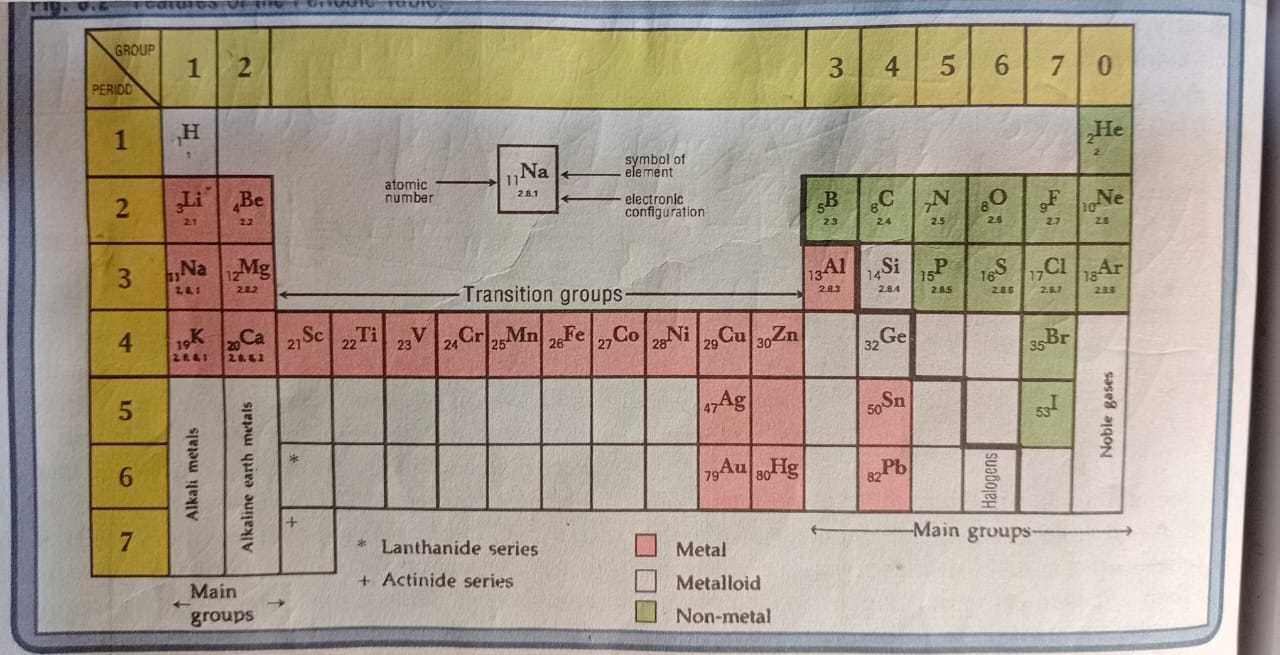
ELECTRONIC CONFIGURATION AND PEIODIC TABLE
The elements in groups 0 to 7 of the periodic table are divided into four blocks based on their outermost energy level. They are placed in s-block, p-block, d-block and f-block. Each block contains specify groups of elements with shared electronic properties.
S-BLOCK
* They are made up of groups 1 and 2 elements on the left of the table
* The elements in this block are the reactive alkali and alkali-earth metals
* Examples are Hydrogen (H), Sodium (Na), Calcium (Ca)
P-BLOCK
* Groups 3 to 7 and 0 on the right side of the table occupies the p-block
* The elements change from moderately active metal (group 3) to the very active non-metals (group 7)
* Inclusive are the unreactive noble gases in group 0
* Examples are Boron (B), Nitrogen (N), Sulphur (S)
D-BLOCK
* The transition metals in the middle of the periodic table form the D-block
* Examples are Manganese (Mn), Iron (Fe), Copper (Cu)
F-BLOCK
* The inner transition metals (lanthanides and actinides) fill f-block.
* The lanthanides and actinides occur between Groups 2 and 3 in Periods 6 and 7
* Examples are Uranium (U), Plutonium (Pu), Thorium (Th)
ELECTRONIC CONFIGURATION OF SOME ELEMENTS
SODIUM - Atomic Number – 11(2, 8, 1) CHLORINE Atomic Number – 17 (2, 8, 7)
1s2 2s2 2p6 3s1
1S2 2S2 2P6 3S2 3P5
Evaluation
1. The first science to construct periodic table is A. Antoine Lavoisier B. Henry Moseley C. Dmitri Mendeleev D. Johann Woifgang
2. Dmitri Mendeleev Periodic Table was based on A. atomic weight B. atomic number C. electrons D. neutron
3. The proton of an atom is _______ charged A. negatively B. positively C. neutrally D. equivalently
4. The valence electron of Magnesium is A. 12 B. 10 C. 8 D. 2
5. The transition elements are located between A. Group 1 and 2 B. Group 2 and 3 C. Group 4 and 5 D. Group 6 and 7
6. The reactive alkali metals are most likely to be found in A. Group 7 B. Group 5 C. Group 1 D. Group 0
7. The element Centum belong to _______ series on the periodic table A. noble B. P-Block C. Lanthanide D. valence
8. The elements in Group 3 to 7 belongs to A. P-Block B. S-Block C. D-block D. F-Block
9. The electronic configuration 1s2 2s2 2p6 3s2 3p6 4s2 belong to which element A. Potassium B. Argon C. Calcium D. Chromium
10. The elements of Actinides are found in A. period 7 B. period 3 C. period 1 D. period 5
Theory Questions
1a) Define Periodic Table
b) State the Periodic law
2a) Mention TWO elements each from i) Group 2 ii) Group 5 iii) Group 0
b) Write the electronic configuration using the s, p, d, f level with the abbreviation for the following elements: i) Manganese ii) Iron iii) Phosphorous