CONCEPTS OF TIME Lesson Note
Learning Objectives: By the end of the lesson, students should be able to:
This SS1 Physics lesson note covers CONCEPTS OF TIME for First Term, Week 5.
Lesson Note
Learning Objectives: By the end of the lesson, students should be able to:
1. Define time as a fundamental physical quantity
2. State the SI unit of time and its standard
3. Explain natural and scientific ways of measuring time
4. Describe instruments for measuring time and their accuracy
5. Solve simple problems on time measurement
CONTENT
CONCEPT OF TIME
In Physics, Time is a fundamental quantity. It is defined as the duration or interval between two successive events. It is a scalar quantity – it has magnitude only.
Time flows continuously and irreversibly. We cannot see or touch time, but we observe its effects e.g. sunrise to sunset, oscillation of a pendulum.
SI Unit of Time: The SI unit of time is second (s).
Since 1967, 1 second is defined using the Atomic Clock as:
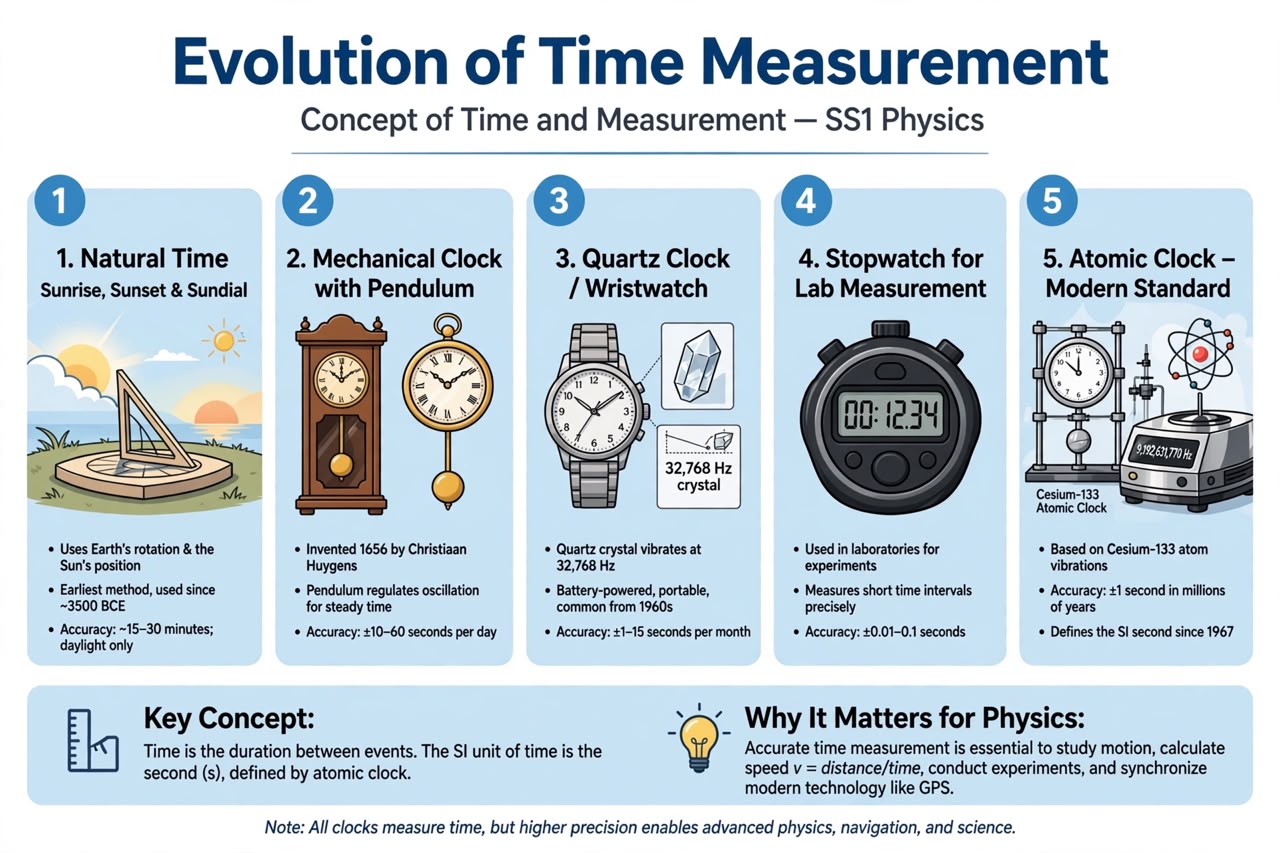
1 second = The time taken for 9,192,631,770 vibrations of Cesium-133 atom.
Other units: Minute (min), Hour (h), Day, Year.
60 s = 1 min, 60 min = 1 hr, 24 hrs = 1 day, 365 days = 1 year
WAYS OF MEASURING TIME – EVOLUTION
A. NATURAL / ANCIENT METHODS
Man, first measured time using natural events.
Day/Night: One complete rotation of earth on its axis (24 hrs)
Month: Based on moon's revolution around earth
Year: Earth's revolution around the sun (365¼ days)
Sundial: Earliest clock, ∼3500 BCE. Uses shadow of the sun. Accuracy: ±15–30 minutes, works only in daylight.
B. MECHANICAL CLOCK WITH PENDULUM
Invented 1656 by Christiaan Huygens. Uses regular swing (oscillation) of a pendulum.
Principle: The period of a pendulum is constant for small swing. Each swing = time interval.
Accuracy: ±10 to 60 seconds per day. Better than sundial.
C. QUARTZ CLOCK / WRISTWATCH
Modern common clock, from 1960s. Uses vibration of quartz crystal.
When battery sends current, quartz vibrates at 32,768 times per second (32,768 Hz). Electronic circuit counts the vibrations to show time.
Accuracy: ±1–15 seconds per month.
D. STOPWATCH FOR LABORATORY MEASUREMENT
Used in Physics lab to measure short time intervals e.g. time of free fall, period of pendulum. Can be analog or digital.
Accuracy: ±0.01 s to 0.1 s. We press start/stop.
Used to determine speed:
v = Distance / Time
E. ATOMIC CLOCK – MODERN STANDARD
Most accurate clock in the world. Based on Cesium-133 atom. Used in satellites, GPS, and to define the second.
Accuracy: ±1 second in 3 million years. It loses/gains 1 second only after millions of years.
This is the standard clock for all scientific measurements.
3. SUMMARY TABLE
| Method | Principle | Accuracy | Use |
|---|---|---|---|
| Sundial | Sun's shadow | ~15 mins | Ancient, daytime only |
| Pendulum Clock | Swing of pendulum | ~30 sec/day | House clocks |
| Quartz Watch | Quartz vibration | ~10 sec/month | Daily use |
| Stopwatch | Electronic counting | 0.01 sec | Physics lab |
| Atomic Clock | Atom vibration | 1 sec/3M years | Scientific standard |
4. IMPORTANCE OF ACCURATE TIME MEASUREMENT
i) Calculation of speed, velocity, acceleration
ii) For experiments on simple pendulum, free fall
iii) For navigation, GPS, aviation
iv) For broadcasting and communication
Evaluation
OBJECTIVE QUESTIONS
1. What is time in Physics?
A) A derived quantity B) A fundamental quantity C) A vector quantity D) An electrical quantity
2. The SI unit of time is:
A) Minute B) Hour C) Second D) Day
3. One second is defined as the time taken for 9,192,631,770 vibrations of:
A) Sodium atom B) Cesium-133 atom C) Quartz crystal D) Pendulum
4. Which of the following is a natural method of measuring time?
A) Quartz watch B) Atomic clock C) Sundial D) Stopwatch
5. A sundial works with:
A) Sand flow B) Sun's shadow C) Battery D) Cesium atom
6. Who invented the pendulum clock in 1656?
A) Isaac Newton B) Christiaan Huygens C) Galileo Galilei D) Albert Einstein
7. Quartz crystal in a wristwatch vibrates at a frequency of:
A) 9,192,631,770 Hz B) 60 Hz C) 32,768 Hz D) 1 Hz
8. Which instrument is most suitable for measuring short time intervals in the Physics laboratory?
A) Sundial B) Wall clock C) Stopwatch D) Calendar
9. The most accurate clock in the world is:
A) Pendulum clock B) Quartz clock C) Atomic clock D) Hourglass
10. All clocks measure time using:
A) Random motion B) Periodic / regularly repeating events C) Linear motion D) Heat energy
PART B: THEORY QUESTIONS
1. (a) Define time and state its SI unit
(b) Explain briefly with diagrams the evolution of time measurement under: (i) Sundial (ii) Pendulum clock (iii) Quartz clock (iv) Atomic clock
(c) A simple pendulum makes 25 complete oscillations in 50 seconds. Calculate: (i) The period of oscillation (ii) The frequency
2. (a) Differentiate between ancient and modern methods of measuring time, give two examples of each.
(b) State three reasons why accurate time measurement is important in Physics and everyday life.
(c) Convert: (i) 2 hours to seconds (ii) 180 seconds to minutes