
INTRODUCTION TO PHYSICS Lesson Note
This SS1 Physics lesson note covers INTRODUCTION TO PHYSICS for First Term, Week 1.
Learning Objectives
- By the end of the lesson, students should be able to:
- 1. Define physics correctly.
- 2. State at least 5 importance of physics.
- 3. Mention and explain the two main branches of physics.
- 4. List examples under each branch.
Lesson Note
A. Introduction
What happens when you switch on your phone torch? Why does a ball thrown up come down? All these observations are what physics tries to answer.
B. Definition of Physics
Physics is a branch of science that deals with the study of matter, energy, and their interactions. It can also be defined as a branch of science that deal with the properties of matter and energy and the relationship between them .
The word Physics comes from a Greek word "Physis" meaning nature. So, physics is the study of nature and the laws governing natural phenomena.
Matter is anything that has mass and occupies space e.g. stone, water, air.
Energy is the ability to do work e.g. light, heat, sound.
C. IMPORTANCE OF PHYSICS
i. In Communication: Physics made mobile phones, radio, TV, satellite possible.
ii. In Medicine: X-ray, ultrasound, CT-scan are from physics.
iii. In Transportation: Cars, aeroplanes, ships work on laws of physics.
iv. In Our Homes: Electricity, refrigerator, pressing iron, fan.
v. In Education and Technology: It is the foundation for engineering, architecture, computer science.
vi. It helps us understand natural phenomena like rainbow, eclipse, earthquake.
D. APPLICATION OF PHYSICS.
1. Telecommunication
2. Energy company
3. Educational Research Institution
4. Information Technology outfit
5. Aviation
6. Medical Diagnostic Industries
7. Space Technology
8. Iron and steel Industries
E. Branches of Physics
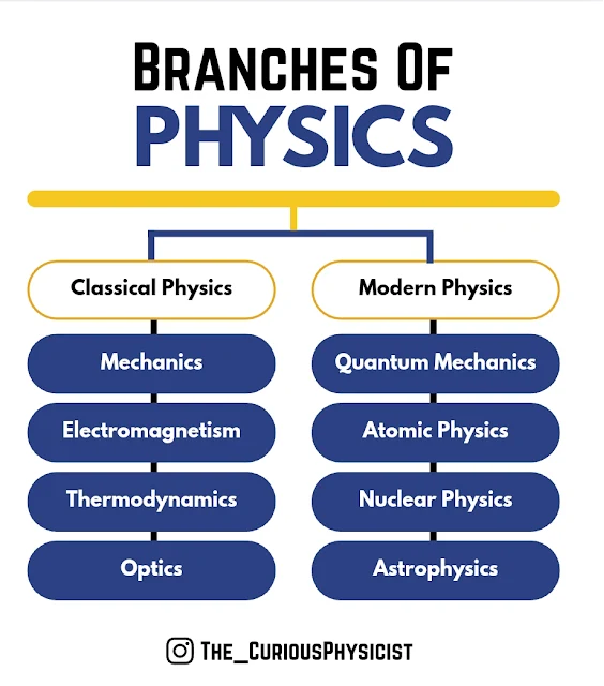
Physics is divided into two major branches:
1. Classical Physics: This deals with phenomena that we can see with our eyes, at normal speeds (not very fast). It was developed before 1900. It includes:
i. Mechanics: Study of motion of bodies - e.g. why cars move, why we fall.
ii. Heat (Thermodynamics): Study of heat and temperature.
iii. Light (Optics): Study of light, reflection, refraction. e.g. How we see.
iv. Sound (Acoustics): Study of sound production.
v. Electricity and Magnetism: Study of electric charges and magnets.
2. Modern Physics: This deals with very small things like atoms and very fast things like light speed. Developed after 1900. It includes:
i. Atomic Physics: Study of structure of the atom.
ii. Nuclear Physics: Study of the nucleus of atom and nuclear energy.
iii. Electronics: Study of flow of electrons in circuits - phones, computers.
iv. Relativity: Study of bodies moving at the speed of light, developed by Albert Einstein.
F. SUMMARY
Physics is all around us. Without physics, there would be no light, no phone, no car.
Evaluation
OBJECTIVE QUESTIONS
1. The Greek meaning of Physics is
A. Matter
B. Nature
C. Energy
D. Power
2. Physics is the study of
A. Animals only
B. Matter and energy
C. Plants only
D. Soil
3. Which of these is an importance of physics in medicine?
A. X-ray machine
B. Cutlass
C. Hoe
D. Bench
4. The branch of physics that deals with light is called
A. Mechanics
B. Acoustics
C. Optics
D. Thermodynamics
5. Study of sound is called
A. Optics
B. Acoustics
C. Mechanics
D. Electronics
6. Classical Physics was developed _____ 1900
A. After
B. Before
C. During
D. In
7. Which of these is NOT a branch of classical physics?
A. Mechanics
B. Nuclear Physics
C. Heat
D. Sound
8. The physicist who developed relativity is
A. Newton
B. Archimedes
C. Einstein
D. Hooke
9. Electronics is classified under
A. Classical
B. Modern
C. Ancient
D. Local
10. Physics helps to explain natural phenomena like
A. Rainbow
B. Gossip
C. Dancing
D. Sleeping
Theory Questions
1a) Define Physics in your own words.
b) Mention FIVE daily activities in your home that depend on Physics and explain how.
2. Differentiate between Classical Physics and Modern Physics with 2 examples each.