
THE CELL Lesson Note
This SS1 Biology lesson note covers THE CELL for First Term, Week 4.
Learning Objectives
- At the end of the lesson, students should be able to:
- Define a cell.
- Explain the cell theory.
- Identify the major parts of a typical cell.
- State the functions of the cell organelles.
- Differentiate between plant and animal cells.
- Explain the importance of cells to living organisms.
- Identify specialised cells and state their functions.
Lesson Note
A. Meaning of a Cell
A cell is the basic structural and functional unit of a living organism.
All living organisms are made up of cells. Some organisms, such as Amoeba, consist of only one cell and are called unicellular organisms, while organisms such as humans, goats and maize plants are made up of many cells and are called multicellular organisms.
Cells are usually microscopic and can be observed clearly with the aid of a microscope.
B. Cell Theory
The cell theory states that:
All living organisms are made up of one or more cells.
The cell is the basic structural and functional unit of life.
All cells arise from pre-existing cells through cell division.
The cell theory shows the importance of the cell in the organization of living organisms.
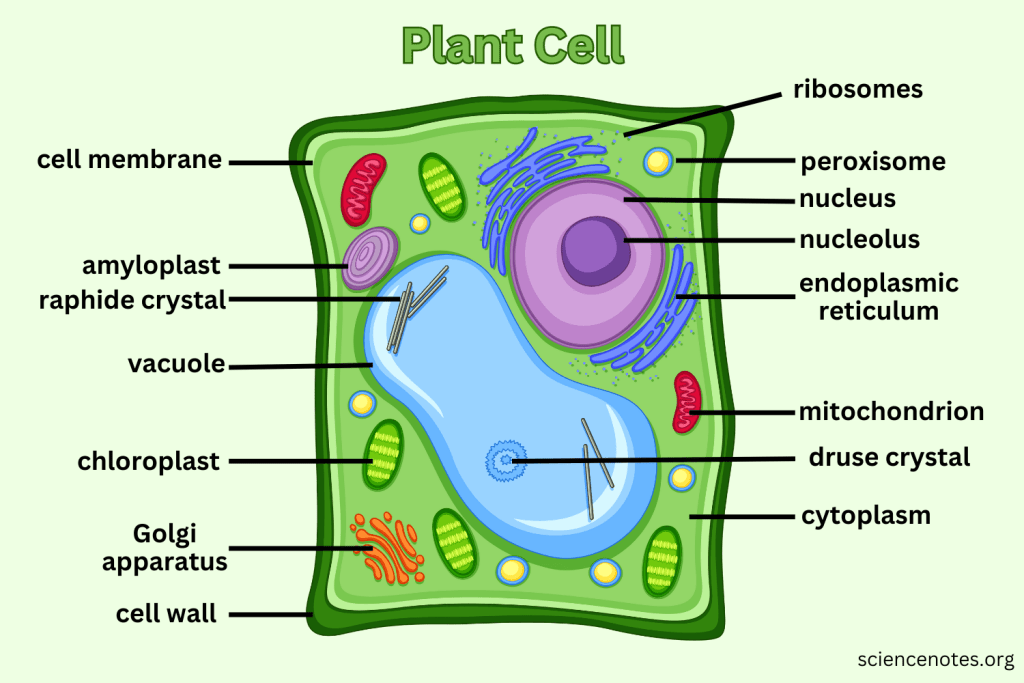
C. Types of Cells
There are two broad types of cells:
1. Plant Cell
A plant cell is the basic unit of a plant.
Plant cells usually contain structures such as: Cell wall, Cell membrane, Cytoplasm, Nucleus, Chloroplasts, Large permanent vacuole, Mitochondria and Ribosomes
2. Animal Cell
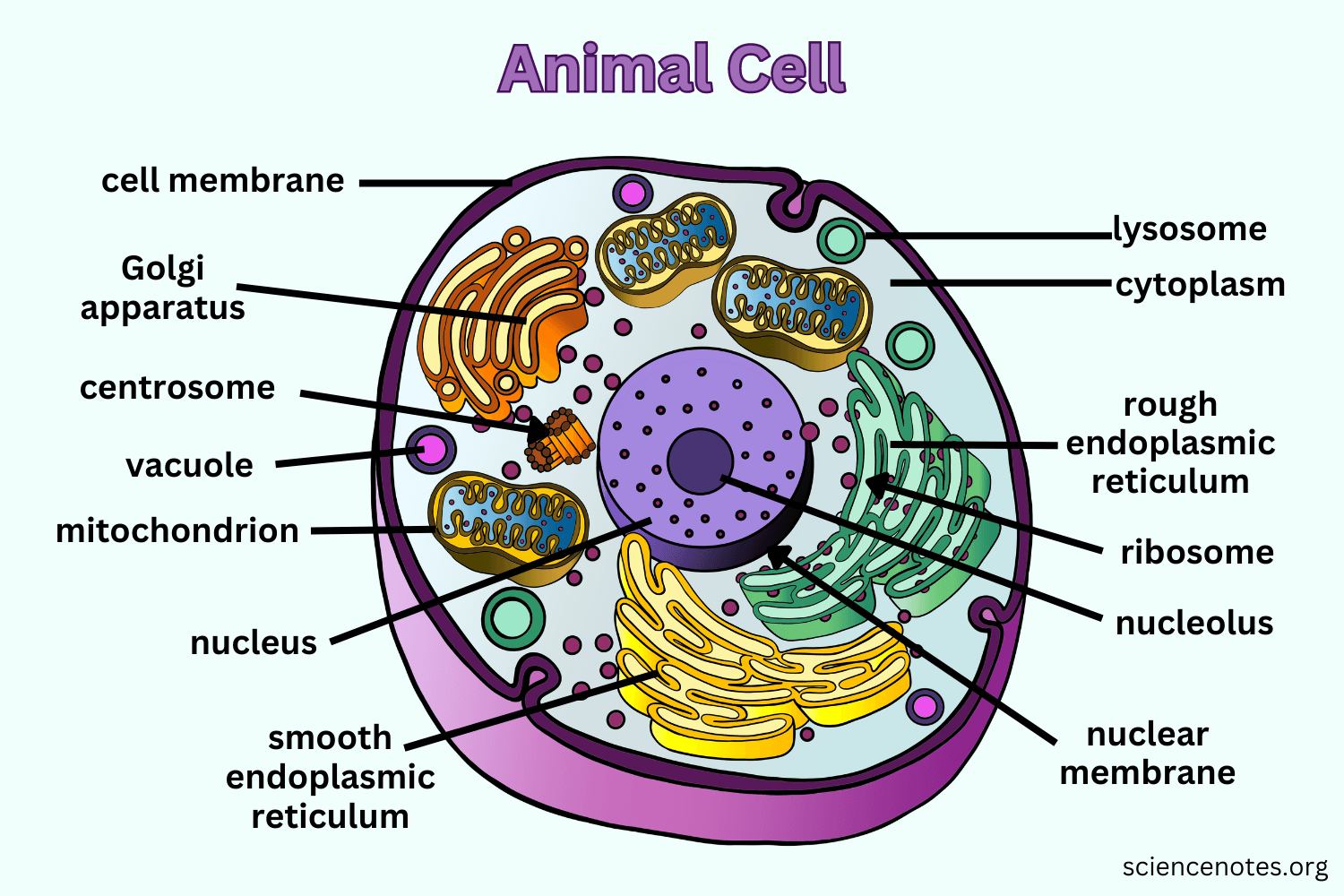
An animal cell is the basic unit of an animal:
Animal cells contain: Cell membrane, Cytoplasm, Nucleus, Mitochondria, Ribosomes and Small vacuoles in some cells
Animal cells do not normally have a cell wall or chloroplasts.
D. Structure and Functions of Cell Organelles
1. Cell Membrane
The cell membrane is a thin membrane surrounding the cell.
Functions
*Controls substances entering and leaving the cell.
*Separates the contents of the cell from the external environment.
*Helps maintain the internal conditions of the cell.
The cell membrane is described as selectively permeable because it allows some substances to pass through more easily than others.
2. Cytoplasm
The cytoplasm is the jelly-like material found between the cell membrane and nucleus.
Functions
*Contains many cell organelles.
*It is the site of many chemical reactions in the cell.
*Helps support the organelles.
3. Nucleus
The nucleus is usually surrounded by a nuclear membrane and contains genetic material.
Functions
*Controls many activities of the cell.
*Contains chromosomes and genetic information.
*Plays an important role in cell division.
4. Mitochondrion
Mitochondria are organelles where aerobic respiration takes place.
Function
*They release usable energy from food during respiration.
Because of their role in energy release, mitochondria are sometimes called the powerhouses of the cell.
5. Ribosomes
Ribosomes are very small structures found in cells.
Function
*They are the sites of protein synthesis.
6. Chloroplast
Chloroplasts are found mainly in green plant cells.
They contain the green pigment chlorophyll.
Function
*They are the main sites of photosynthesis, during which plants manufacture food using light energy.
7. Cell Wall
The cell wall is a strong outer layer found outside the cell membrane of plant cells.
It is mainly made of cellulose.
Functions
*Provides support.
*Gives the plant cell a definite shape.
*Protects the cell.
*Prevents the cell from bursting when it takes in excess water.
8. Vacuole
A plant cell usually contains a large permanent vacuole containing cell sap.
Functions
*Stores water and dissolved substances.
*Helps maintain the firmness of plant cells.
*Helps maintain turgor in plant tissues.
E. Differences Between Plant and Animal Cells
Plant Cell Animal Cell
Has a cellulose cell wall. Has no cell wall.
Has chloroplasts in green cells. Does not have chloroplasts.
Usually has a large permanent vacuole. Usually has small temporary vacuoles or none.
Usually has a more regular shape. Often has a more irregular or rounded shape.
Stores carbohydrate mainly as starch. Stores carbohydrate mainly as glycogen.
F. Similarities Between Plant and Animal Cells
Both plant and animal cells:
Have a cell membrane.
Contain cytoplasm.
Have a nucleus in most mature cells.
Contain mitochondria.
Contain ribosomes.
Carry out various metabolic activities.
Require nutrients and energy to perform their functions.
Unicellular and Multicellular Organisms
G. Unicellular Organisms
These organisms consist of one cell.
Examples include: Amoeba, Paramecium, Chlamydomonas, Many bacteria and Yeast
The single cell performs all necessary life processes.
H. Multicellular Organisms
These organisms consist of many cells.
Examples include: Humans, Goats, Fish, Maize and Mango trees
In multicellular organisms, cells may become specialised for different functions.
I. Specialised Cells
A specialised cell is a cell that has a particular structure adapted to perform a specific function.
Examples:
*Red blood cell: Transports oxygen around the body.
*Nerve cell (neurone): Transmits electrical impulses.
*Sperm cell: Designed to move towards and fertilise an egg cell.
*Root hair cell: Absorbs water and mineral salts from the soil.
*Palisade cell: Specialised for photosynthesis because it contains many chloroplasts.
Guard cells: Control the opening and closing of stomata in leaves.
J. Importance of Cells
Cells are important because:
They form the bodies of living organisms.
They carry out life processes.
They provide energy through respiration.
They enable organisms to grow.
They allow organisms to reproduce.
They remove waste products.
Specialised cells perform specific functions.
Groups of cells form tissues.
Tissues combine to form organs.
Organs work together as organ systems.
K. Organization of Cells in Multicellular Organisms
In higher organisms, cells are organised into different levels:
Cell → Tissue → Organ → Organ System → Organism
For example:
Muscle cell → Muscle tissue → Heart → Circulatory system → Human
This organisation allows different parts of the body to perform specialised functions efficiently.
Summary
The cell is the basic structural and functional unit of life. Living organisms may be unicellular or multicellular. Plant and animal cells have some structures in common, such as the cell membrane, cytoplasm, nucleus, mitochondria and ribosomes, but plant cells also possess structures such as the cell wall, chloroplasts and large permanent vacuole.
In multicellular organisms, cells become specialised and are organised into tissues, organs and organ systems. Each cell organelle performs specific functions necessary for the survival and proper functioning of the cell.
Evaluation
OBJECTIVE QUESTIONS
The basic structural and functional unit of life is the
A. Tissue
B. Organ
C. Cell
D. Organ system
Which cell organelle controls many activities of the cell?
A. Vacuole
B. Nucleus
C. Ribosome
D. Chloroplast
The organelle where aerobic respiration mainly takes place is the
A. Nucleus
B. Chloroplast
C. Mitochondrion
D. Cell wall
Which structure is found in plant cells but not normally in animal cells?
A. Cytoplasm
B. Cell membrane
C. Cell wall
D. Ribosome
The green pigment found in chloroplasts is called
A. Hemoglobin
B. Chlorophyll
C. Melanin
D. Glycogen
The main function of ribosomes is
A. Protein synthesis
B. Photosynthesis
C. Water absorption
D. Waste removal
Which of the following is a unicellular organism?
A. Human
B. Goat
C. Amoeba
D. Maize plant
The cell structure that controls the movement of substances into and out of the cell is the
A. Cell wall
B. Cell membrane
C. Nucleus
D. Vacuole
Which specialised cell absorbs water and mineral salts from the soil?
A. Red blood cell
B. Nerve cell
C. Root hair cell
D. Sperm cell
Which sequence correctly shows the organisation of multicellular organisms from simplest to most complex?
A. Organ → Cell → Tissue → Organism
B. Cell → Tissue → Organ → Organ System → Organism
C. Tissue → Cell → Organ → Organism
D. Cell → Organ → Tissue → Organism
Theory Questions
1a. Define a cell and state the three main statements of the cell theory.
1b. Draw and label a typical plant cell, and state the functions of five cell organelles.
2a. State five differences between plant and animal cells.
2b. What is a specialised cell? Mention four specialised cells and state one function of each.
2c. Differentiate between unicellular and multicellular organisms, giving three examples of each