
POLYMER, GIANTS AND MACRO MOLECULES Lesson Note
Learning Objectives: By end of lesson, students should be able to:
This SS3 Chemistry lesson note covers POLYMER, GIANTS AND MACRO MOLECULES for First Term, Week 5.
Lesson Note
Learning Objectives: By end of lesson, students should be able to:
1. Define polymer, monomer, macromolecule and giant molecule
2. Distinguish between natural and synthetic polymers
3. Explain polymerization (addition and condensation)
4. Explain giant covalent structures and give examples
5. List properties and uses
CONTENT
DEFINITION OF TERMS
Monomer: A small simple molecule that can join with other similar molecules to form a very large molecule.
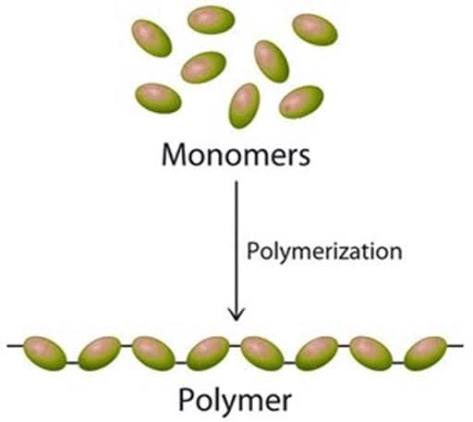
E.g. Ethylene (C2H4), Glucose, Amino acid
Polymer: A very large molecule (macro-molecule) formed by joining together many small monomers repeatedly.
Word: Poly = many, mer = parts.
E.g. Polythene from ethylene, Starch from glucose.
Polymerization: The process by which monomers join to form polymer. nM → [M]n where n = thousands.
Macromolecule / Giant Molecule: A very large molecule containing thousands of atoms bonded together in a huge network. All polymers are macromolecules. They have very high molecular mass.
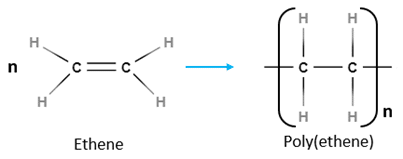
Ethylene (Monomer) C2H4 → Addition polymerization (heat, pressure, catalyst) → Polythene (Polymer) -[CH2-CH2]n-
n = many thousands. The double bond C=C breaks to form single bonds linking long chain.
GIANT MOLECULE STRUCTURES (Giant Covalent Structures)
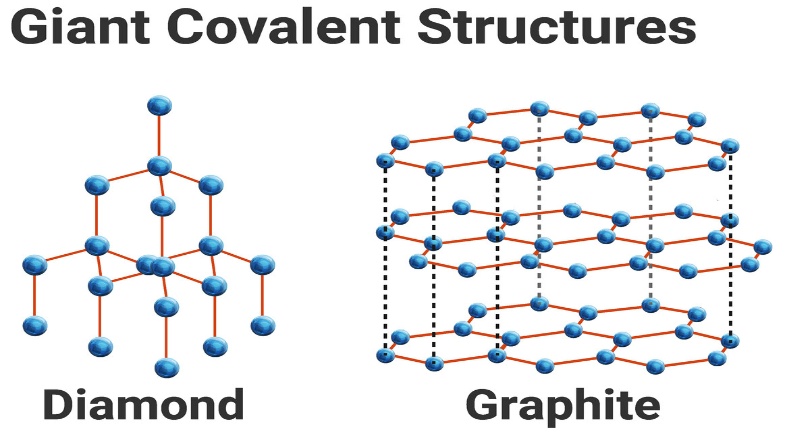
These are not typical polymers but are macromolecules where atoms are linked by strong covalent bonds throughout the entire crystal, forming a huge 3D network. They have no discrete small molecules.
A) Diamond:
• Each carbon bonded to 4 other carbons in tetrahedral arrangement.
• Giant 3D network.
• Properties: Very hard (hardest natural substance), very high melting point 3550°C, does not conduct electricity (no free electrons), insoluble.
• Uses: Cutting tools, jewellery.
B) Graphite:
• Carbon atoms in flat hexagonal layers, layers held by weak forces.
• Each carbon bonded to 3 carbons in layer.
• Properties: Soft, slippery (layers slide), conducts electricity (free electrons between layers), high melting point.
• Uses: Pencil lead, electrode, lubricant.
C) Silica / Silicon dioxide (SiO2) - Sand/Quartz:
• Each Si bonded to 4 O, each O to 2 Si, giant 3D network.
• Properties: Very hard, high melting point 1713°C, insoluble.
• Uses: Glass, sand, ceramics.
Other giant molecules: Silicon carbide (SiC)
TYPES OF POLYMERS
A) Based on Origin - See Diagram 3 in chart:
i) Natural Polymers - From nature, in living things:
• Cellulose: From glucose monomer, in plants, cotton, wood. For paper, cloth.
• Starch: From glucose, in potato, rice. Food storage.
• Protein: From amino acids monomer, in wool, silk, hair, egg. Body building.
• Natural Rubber: From isoprene (2-methylbut-1,3-diene), from rubber tree latex. Elastic.
• Nucleic Acids: DNA, RNA from nucleotides.
ii) Synthetic Polymers - Man-made in lab/factory:
• Polythene (Polyethylene): From ethylene, bags, bottles, pipes.
• PVC (Polyvinyl chloride): From vinyl chloride, pipes, flooring, bottles.
• Nylon (Polyamide): From diamine + dicarboxylic acid, strong fiber for clothes, parachutes, ropes.
• Terylene / Polyester: Clothes, PET bottles.
• Perspex, Bakelite, Polystyrene
B) Based on Method of Formation:
i) Addition Polymerization: Monomers join without loss of any small molecule. Double bond breaks. E.g. Polythene, PVC, Polypropylene.
General: nCH2=CH2 → -[CH2-CH2]n-
ii) Condensation Polymerization: Monomers join with loss of small molecules like H2O, HCl. E.g. Nylon, Terylene, Protein (water lost). Requires two different functional groups.
PROPERTIES OF POLYMERS / MACROMOLECULES
1. Very large molecular mass
2. Insoluble in water but some soluble in organic solvents
3. Low density, light weight
4. Can be hard or flexible
5. Poor conductors of electricity (except graphite)
6. Chemically inert (do not react easily)
7. Have high melting points if giant covalent
Uses: Plastics, clothing, tyres, containers, insulators, synthetic hair, pipes.
Illustration Chart:
GENERAL SUMMARY
1. Monomer is small building block e.g ethylene C2H4, glucose.
2. Polymer is giant molecule formed when many monomers join: n(monomer) → Polymer. Process is polymerization.
3. Macromolecule / Giant molecule means very large molecule with thousands of atoms. All polymers are macromolecules. Giant covalent structures like diamond, graphite, silica are also macromolecules with 3D network of strong covalent bonds.
4. Two types of polymerization: Addition (no small molecule lost e.g polythene) and Condensation (water/HCl lost e.g nylon, protein).
5. Two sources: Natural polymers (cellulose, starch, protein, natural rubber from plants/animals) and Synthetic polymers (polythene, PVC, nylon, polyester man-made).
6. Properties: Light, strong, inert, insulators, high melting point for giant covalent. Used in almost everything: bags, clothes, bottles, tyres, tools.
Evaluation
OBJECTIVE QUESTIONS
1. A small molecule that joins repeatedly to form a polymer is called:
A) Polymer
B) Macromolecule
C) Monomer
D) Isomer
2. The process of forming polymer from monomers is:
A) Hydrolysis
B) Polymerization
C) Evaporation
D) Distillation
3. Which of the following is the monomer of polythene?
A) Glucose
B) Amino acid
C) Ethylene (C2H4)
D) Vinyl chloride
4. -[CH2-CH2]n- represents:
A) Monomer
B) Polythene polymer
C) Diamond
D) Starch
5. A very large molecule containing thousands of atoms is called:
A) Micromolecule
B) Macromolecule / Giant molecule
C) Diatomic molecule
D) Isotope
6. Which is a giant covalent structure with each carbon bonded to 4 carbons?
A) Graphite
B) Diamond
C) Polythene
D) PVC
7. Which conducts electricity among giant structures?
A) Diamond
B) Silica
C) Graphite
D) Sand
8. Which is a natural polymer?
A) Polythene
B) Nylon
C) Cellulose
D) PVC
9. Which is a synthetic polymer?
A) Starch
B) Protein
C) Nylon
D) Natural rubber
10. Addition polymerization differs from condensation because:
A) Addition loses water
B) Condensation loses small molecule like water, addition does not
C) Both lose water
D) None
THEORY QUESTIONS
1. (a) Define: (i) Monomer (ii) Polymer (iii) Polymerization (iv) Macromolecule
(b) With diagram, explain the formation of polythene from ethylene. State the type of polymerization
(c) Distinguish between natural and synthetic polymers, give two examples each
2. (a) What is a giant covalent structure? Mention three examples
(b) Describe the structure of (i) Diamond (ii) Graphite. Explain why graphite conducts electricity and is slippery while diamond is hard and does not conduct
(c) Differentiate between addition polymerization and condensation polymerization with examples