
COMPOUND AND MIXTURE Lesson Note
Learning Objectives: By the end of lesson, students should be able to:
This SS1 Chemistry lesson note covers COMPOUND AND MIXTURE for First Term, Week 5.
Lesson Note
Learning Objectives: By the end of lesson, students should be able to:
1. Define element, compound and mixture
2. Differentiate between compound and mixture
3. Give examples of compound and mixture
4. Explain methods of separating mixtures
5. State importance of compounds and mixtures
CONTENT
1. REVIEW OF MATTER
Matter is anything that has mass and occupies space. Matter is divided into:
• Pure substances: Elements and Compounds
• Impure substances: Mixtures
ELEMENT
Simplest pure chemical substance that cannot be broken into simpler substances by chemical means. E.g. Hydrogen (H), Oxygen (O), Sodium (Na), Iron (Fe)
COMPOUND
Definition: A compound is a pure substance formed when two or more elements chemically combine together in a fixed proportion by mass.
A chemical bond is formed, and a new substance with entirely different properties is produced.
Examples:
• Water: H2O = 2 Hydrogen + 1 Oxygen chemically combined
• Common salt: NaCl = Sodium + Chlorine
• Carbon dioxide: CO2
• Calcium carbonate: CaCO3
• Sulphuric acid: H2SO4
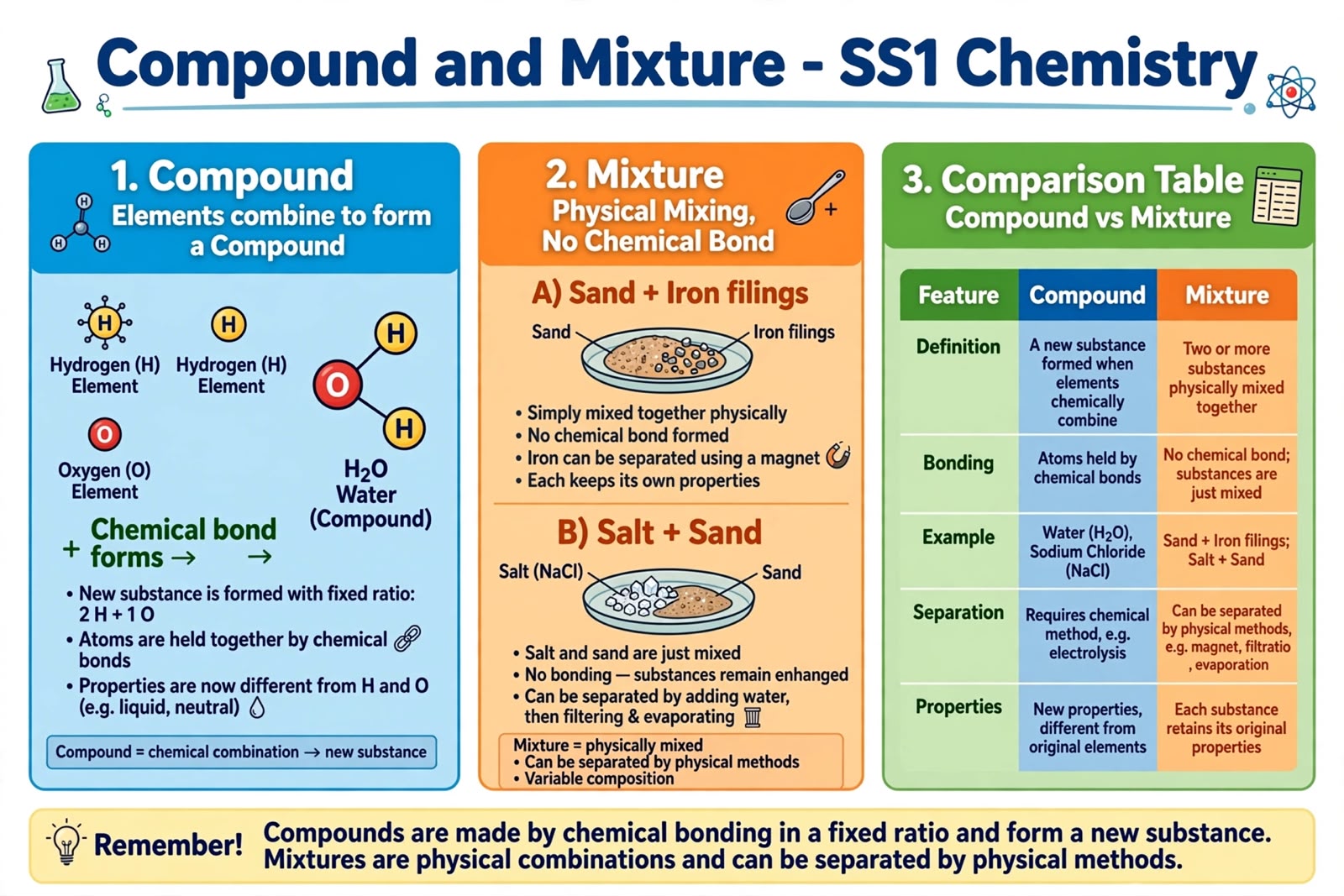
COMPOUND FORMATION:
Hydrogen (element) + Hydrogen (element) + Oxygen (element) → Chemical bond forms → Water H2O (Compound)
Ratio is fixed: 2 H : 1 O always. You cannot have H1.5O.
CHARACTERISTICS OF COMPOUND
1. Formed by chemical combination
2. Elements in fixed ratio by mass (Law of definite composition)
3. Properties completely different from constituent elements. E.g. H2 is explosive gas, O2 supports burning, but H2O is liquid that quenches fire.
4. Requires chemical method to separate e.g. electrolysis of water to get H2 and O2
5. Has definite melting and boiling points
6. Homogeneous - same throughout
MIXTURE
Definition: A mixture is formed when two or more substances are physically combined together, no chemical bond is formed.
Each component retains its own properties.
Examples:
• Sand + Iron filings
• Salt + Sand
• Sugar + Water solution
• Air (mixture of gases)
• Blood
A) Sand + Iron filings: Simply mixed physically. No bond. Iron can be removed with magnet. Each keeps its properties.
B) Salt + Sand: Just mixed. No bonding. Can separate by adding water (salt dissolves, sand does not), filter and evaporate.
CHARACTERISTICS OF MIXTURE
1. Formed by physical combination
2. Variable composition - any amount can mix
3. Each component retains its own properties
4. Can be separated by physical methods: Filtration, Evaporation, Magnet, Distillation,
Chromatography
5. No new substance formed
6. May be homogeneous (uniform e.g. salt solution) or heterogeneous (non-uniform e.g.
sand + iron)
DIFFERENCES BETWEEN COMPOUND AND MIXTURE
| Feature | Compound | Mixture |
|---|---|---|
| Definition | Elements chemically combined | Substances physically mixed |
| Bonding | Chemical bond exists | No chemical bond |
| Ratio | Fixed ratio | Variable ratio |
| Properties | New properties different from elements | Each retains original property |
| Separation | Chemical method only | Physical method |
| Example | H2O, NaCl, CO2 | Sand + Iron, Salt + Sand, Air |
5. GENERAL SUMMARY
1. Element is simplest substance e.g H, O, Na.
2. Compound is when two or more elements CHEMICALLY join in fixed ratio to form a new substance with new properties. Example H2O formed from 2H + O. Needs chemical method like electrolysis to separate. It has fixed melting/boiling point.
3. Mixture is when two or more substances PHYSICALLY mix with no bonding. Each substance keeps its property. Composition is variable. Example Sand + Iron filings can be separated by magnet, Salt + Sand by dissolving, filtering and evaporation.
4. Compounds are pure and homogeneous, mixtures can be homogeneous or heterogeneous.
5. Importance: Most things we use are mixtures (air, blood, food) while useful chemicals are compounds (water, salt, drugs).
Evaluation
OBJECTIVE QUESTIONS
1. The simplest pure substance that cannot be broken down by chemical means is:
A) Compound
B) Mixture
C) Element
D) Solution
2. A pure substance formed when two or more elements chemically combine in fixed ratio is:
A) Mixture
B) Compound
C) Element
D) Alloy
3. Water H2O is a compound because:
A) It is physically mixed
B) Hydrogen and Oxygen are chemically combined in ratio 2:1
C) It can be separated by magnet
D) Its composition is variable
4. Which of the following is a compound?
A) Air
B) Sand + Iron
C) Sodium chloride (NaCl)
D) Blood
5. Which of the following is a mixture?
A) CO2
B) CaCO3
C) Air
D) H2SO4
6. In a mixture, the components:
A) Lose their properties
B) Retain their properties
C) Form new properties
D) Cannot be separated
7. Compounds are separated by:
A) Physical methods
B) Chemical methods
C) Magnet
D) Filtration
8. Sand and iron filings can be separated by:
A) Evaporation
B) Using magnet
C) Electrolysis
D) Distillation
9. Which statement is true about mixture?
A) Fixed composition
B) Formed by chemical bonding
C) Variable composition
D) Has new properties
10. Salt and sand mixture can be separated by:
A) Dissolving in water, filtering, evaporating
B) Using magnet only
C) Electrolysis
D) Cannot be separated
THEORY QUESTIONS
1. (a) Define: (i) Element (ii) Compound (iii) Mixture
(b) State four differences between compound and mixture
(c) Classify as element, compound or mixture: (i) Oxygen gas O2 (ii) Blood (iii) Carbon dioxide CO2 (iv) Salt + Sand (v) Iron (Fe)
2. (a) With the aid of diagram, explain how water as a compound is formed from Hydrogen and Oxygen. Why is water different from a mere mixture of Hydrogen and Oxygen?
(b) Describe how you would separate: (i) Mixture of sand and iron filings (ii) Mixture of salt and sand in the laboratory
(c) Give two characteristics of compounds and two characteristics of mixtures