
INTROUCTION TO CHEMISTRY Lesson Note
This SS1 Chemistry lesson note covers INTROUCTION TO CHEMISTRY for First Term, Week 1.
Learning Objectives
- At the end of the class, students should be able to
- Define the subject
- Know the importance of chemistry as a subject
- Know the application of chemistry
- Know the scientific method
Lesson Note
A. DEFINITION OF CHEMISTRY
Chemistry can be defined as a branch of science which deals with the structure and composition of matter and the changes matter undergoes.
B. WHAT IS MATTER:
Matter is anything that has mass and occupies space. (e.g water, air, stone, book, pen, chair).
Simply: Chemistry is the study of what things are made of and what happens when they react.
C. BRANCHES OF CHMISTRY
There are 5 major branches:
Physical Chemistry: Deals with principles and laws governing chemical reactions, energy, rate, equilibrium. The mathematics of Chemistry.
Organic Chemistry: Deals with the study of carbon an its compounds e.g petrol, plastics, alcohol, fats, protein.
Inorganic Chemistry: Deal with the study of element, their properties and uses e.g. salts, bases, metals
Analytical Chemistry: Deals with the methods of detecting an measuring composition of substances e.g qualitative and quantitative analysis.
Industry Chemistry: Application of chemistry principles to large scale production in industries.
Other branches are biochemistry, nuclear chemistry, environmental chemistry.
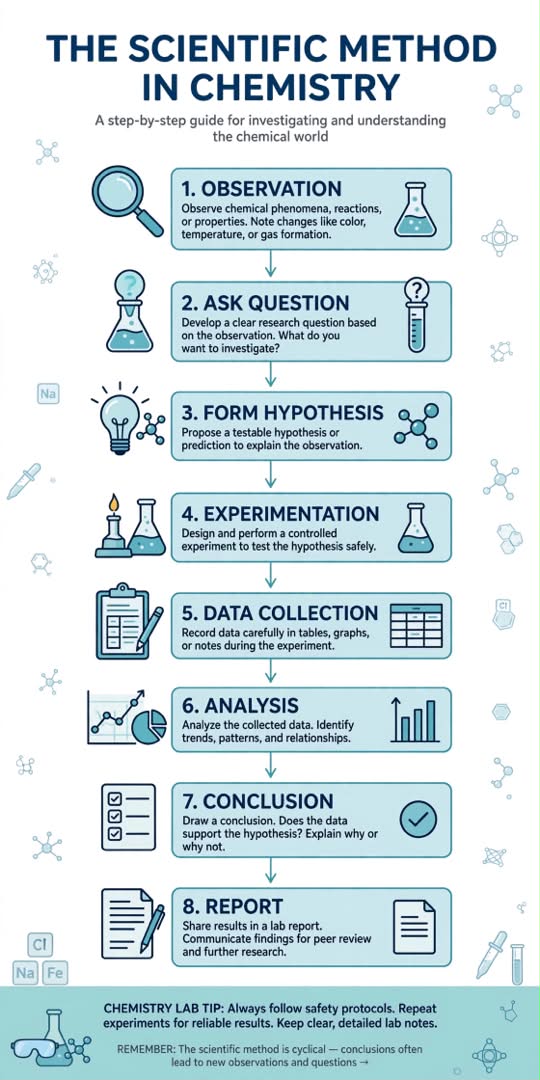
D. THE SCIENTIFIC METHOD OF DISCOVERY
The scientific method of discovery includes the following steps and stages.
E. IMPORTANCE AND APPLICATION OF CHEMISTRY
Transportation: Fuel (petrol, diesel), lubricant, battery, tyres.
Pharmacy/Medicine: Manufacture of drugs, paracetamol, antibiotics, vaccine to cure diseases
Agriculture: Production of fertilizers (NPK, Urea), pesticides, herbicides to increase food yield.
Food Industry: Food preservation, canning, flavouring, food additives.
Clothing/Textile: Production of synthetic fibres such as nylon, polyester
F. ADVERSE EFFECT OF CHEMISTRY
CORROSION
DRUG ABUSE
G. CAREER PROSPECT IN CHEMISTRY
Pharmaceutical Chemistry
Science Education
Chemical Engineering
Pure and applied science
Medicine and surgery.
Biochemistry
Science laboratory technology.
Evaluation
SECTION A: OBJECTIVES (10 Questions)
1. Chemistry can be defined as the study of:
A) Living things
B) Composition, structure and behaviour of matter
C) Stars and planets
D) Numbers
2. Anything that has mass and occupies space is called:
A) Element
B) Matter
C) Atom
D) Mixture
3. The Arabic word "Al-Kimia" means:
A) Study of life
B) Art of transformation
C) Central science
D) Study of metals
4. Chemistry is called the Central Science because:
A) It is in the middle of timetable
B) It links other sciences like Physics, Biology, Medicine
C) It is difficult
D) It was first science
5. Which of these is an example of matter?
A) Light
B) Heat
C) Air
D) Sound
6. The branch of Chemistry that deals with compounds containing carbon and hydrogen is:
A) Inorganic Chemistry
B) Physical Chemistry
C) Organic Chemistry
D) Analytical Chemistry
7. The branch of Chemistry that deals with large scale production in industries is:
A) Nuclear Chemistry
B) Industrial Chemistry
C) Biochemistry
D) Geochemistry
8. Which of the following is NOT a laboratory rule?
A) Do not eat in the lab
B) Taste every chemical to identify it
C) Wear lab coat and goggles
D) Report accidents immediately
9. The correct way to dilute acid is:
A) Add water to acid
B) Add acid to water
C) Add both at same time
D) Heat acid first
10. A person who produces drugs and medicines using Chemistry is a:
A) Farmer
B) Pharmacist
C) Driver
D) Lawyer
Theory Questions
1a) Define Chemistry and Matter.
1b) Give 3 examples of matter around you.
2b) List and explain 3 major branches of Chemistry with one example each.
2c) State 3 importance of Chemistry in everyday life.